

I keep hearing the same argument about Laguna Beach Unified: scores are low or declining, spending is too high, post-COVID testing is inflated, and the district is underperforming because only about 59% of students are meeting or exceeding standards in high school math.
That number matters, but it should not carry the entire story of the district.
I attended La Cañada Unified schools, a high-performing district that was recently ranked 7th in the country. I know what a small, academically focused community feels like because I grew up in one. I am grateful for that education, but I also know the limits of a school culture built almost entirely around academic achievement.
Academics are important, but so is creativity, counseling, independence, arts, athletics, career pathways, emotional development, and a school culture where children are known as people. This is why my husband and I chose Laguna Beach Unified Schools.
First, we have to read the scores correctly. CAASPP and Smarter Balanced are not old-style letter grades. California’s system is standards-based, and state assessment results are meant to be reviewed alongside other measures, including grades, assignments, report cards, and teacher feedback.
So yes, we should look at Laguna’s high school math number, but then we should look around it.
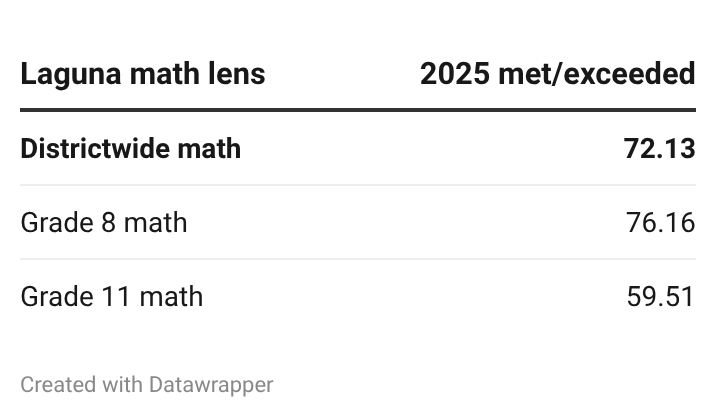
Laguna remains strong compared with Irvine, Capistrano, Newport-Mesa, and the state. Laguna Beach Unified also has the highest scores in Orange County, a highly competitive region for public education.
High school math should stay on the radar, but using a single number as proof of districtwide failure does not hold up, especially when high school math has been a lower metric for Laguna since the early Smarter Balanced years.
The better conversation is this: Laguna is strong overall, has excellent middle school results, and should continue improving its high school math.
Spending also needs some context.
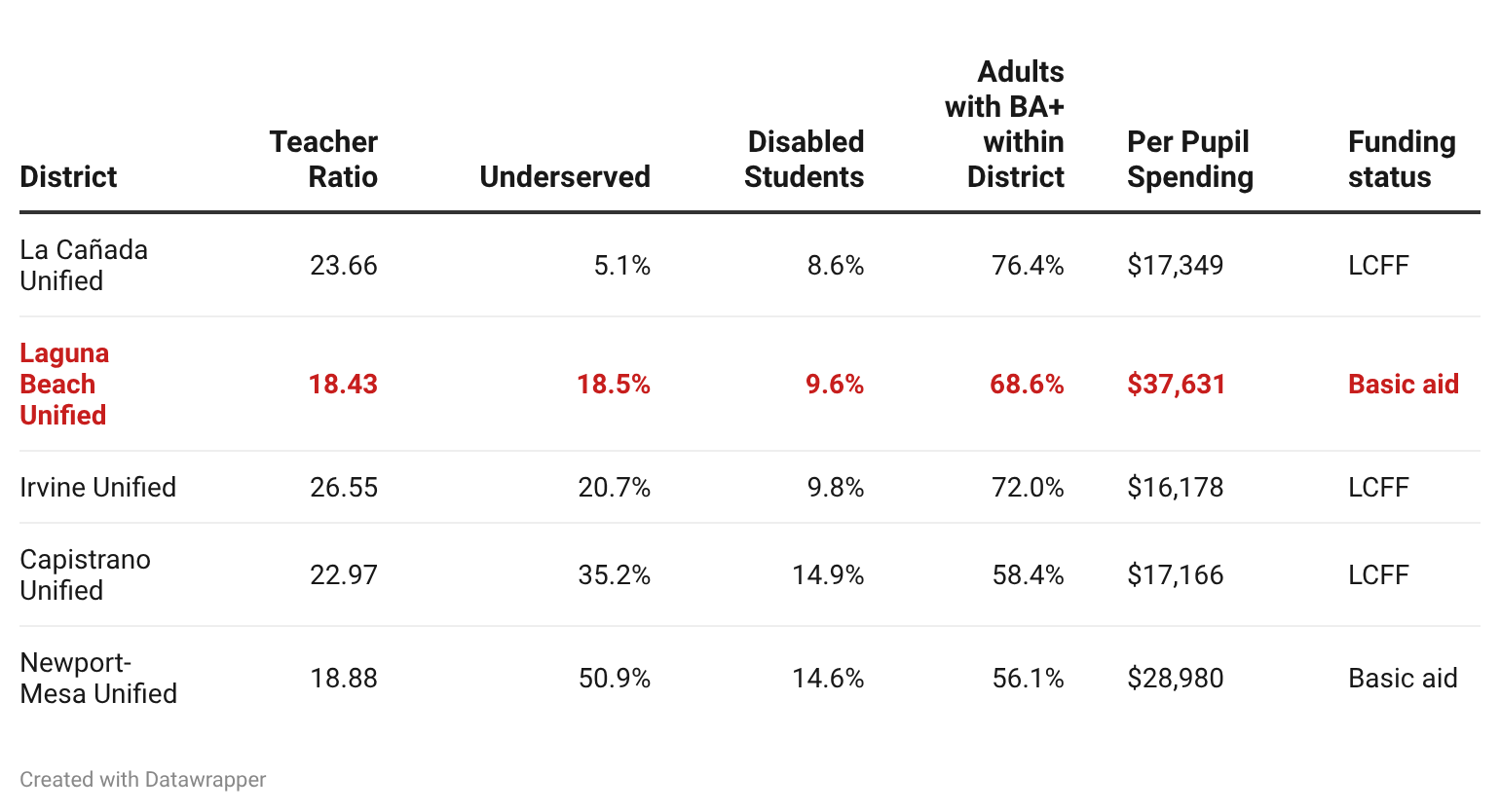
Laguna spends more per pupil - something I’ve covered before. A small basic-aid district has a different cost structure, but the right question is still what students receive for that investment.
That includes smaller ratios, counseling, special education, intervention systems, AP, CTE, arts, athletics, facilities, and the staff needed to make those systems work.
This is where the Local Control & Accountability Plan (LCAP) matters. The LCAP connects goals, actions, services, spending, and student outcomes. Laguna’s LCAP focuses on college and career readiness, social-emotional competencies, student identity, and safe, welcoming schools.
That work is much more complex than a single test score.
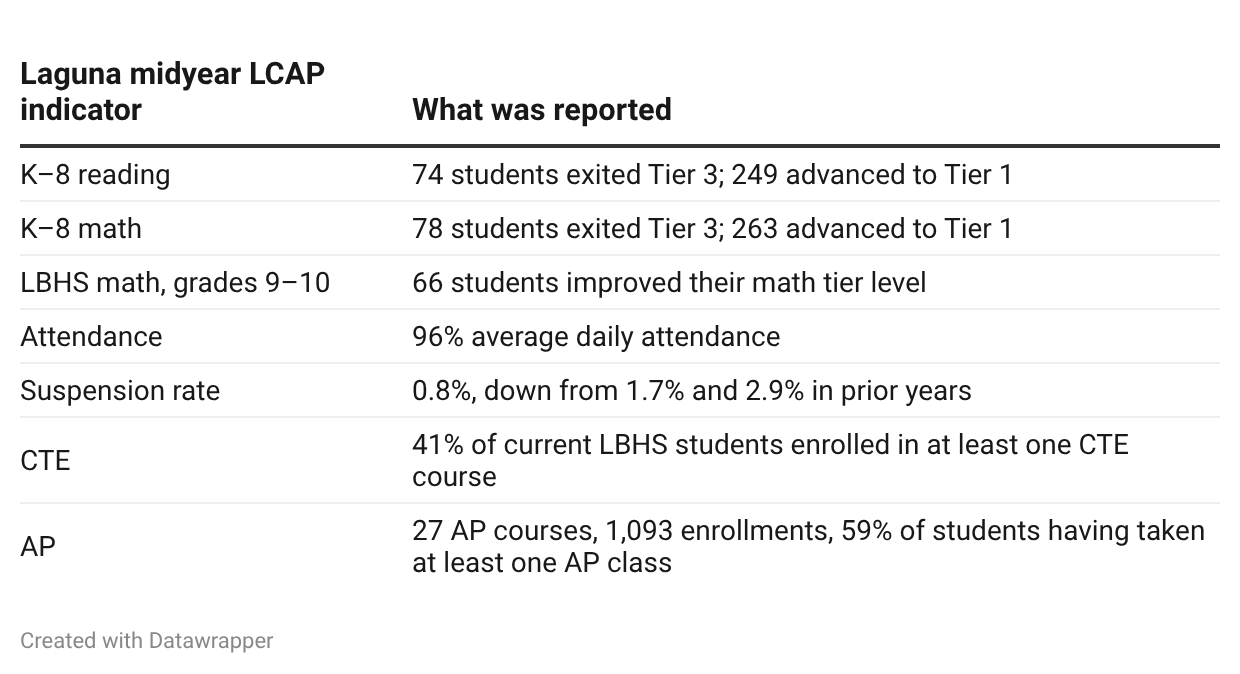
The district’s midyear LCAP update shows how students are being identified, supported, monitored, and moved. For example, a student may be Tier 1 (meets or exceeds standards) in math but Tier 3 (needs significant intervention) in reading. He may understand math, but have difficulty with fluency, comprehension, vocabulary, or confidence. If something is also happening at home, test scores alone will not tell that story.
A strong school system ought to address both needs: the academic and the human. That is whole-child education in practice: structured, specific, and labor-intensive.
The LCAP also provides a clearer view of student groups and the student experience. Economically disadvantaged students reached 73.55% proficiency in ELA and 60% in math in the 2024 CAASPP discussion. Students with disabilities improved year over year in both ELA and math, while staying below the district average. English learners also showed strong progress, with 70.7% of students with comparative ELPAC data making progress toward English proficiency.
LBUSD reported that 97% of students in grades 5–12 agreed or were neutral about feeling safe at school. The LCAP also reports that 85% of students agreed their teachers care about them, 88% said they have at least one adult at school who supports them, and 80% of students and 83% of parents agreed that schools provide a safe environment where all opinions are valued.
That does not replace academic outcomes, but helps explain why families value Laguna Beach Unified’s approach.
Laguna Beach High School also delivers considerable opportunities for a small high school. LBHS reports 820 students, 51 teachers, a 208:1 counselor ratio, an average class size of 22, 27% pathway completers, 36% dual enrollment, and 85% earning college credit through CTE, AP, or dual enrollment. The midyear LCAP also reports 27 AP courses, 1,093 AP enrollments, 41% of LBHS students enrolled in at least one CTE course, and 59% of LBHS students having taken at least one AP class.
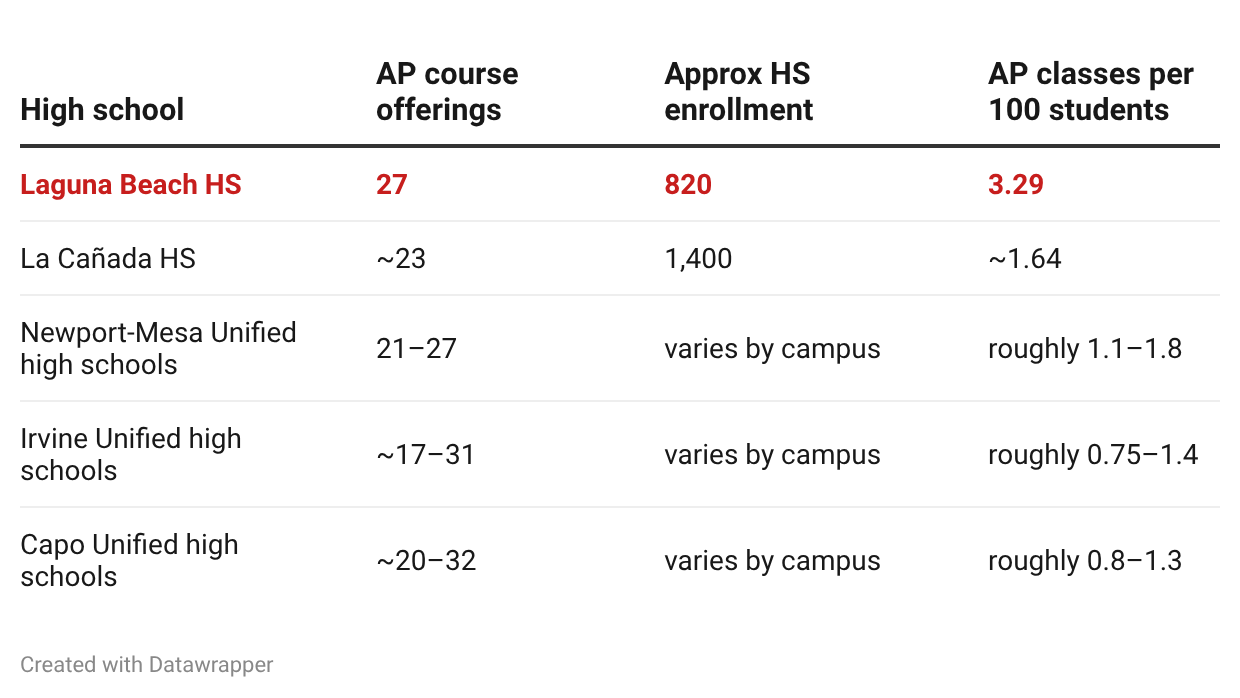
Those numbers show a school preparing students for college, careers, and life after graduation.
LCAP Community Convening is Today

LBUSD is inviting students, families, staff, and community members to review district progress and give input for the upcoming year. The event is today, Thursday, April 30, from 4 to 5:30 p.m. at Laguna Beach High School. Childcare will be available for students in kindergarten through fifth grade, and the district is asking attendees to register in advance through the link on its event page.
The district says participants will review student outcome data, including academic performance, engagement, and school climate; examine progress on current LCAP goals, actions, and services; and provide input to inform the Annual Update and future planning.
Instead of asking whether one snapshot proves a point, we should be asking better questions:
Are reading and math interventions working for the students who need the most support?
How are students with disabilities, economically disadvantaged students, and multilingual learners doing compared with the district overall?
Are teachers, counselors, classified staff, and intervention staff being given the time and resources to do this work well?
Is the district spending money in areas most closely connected to student needs?
How can the board and community assist Dr. Glass, teachers, staff, and site leaders in this work?
These are the questions that help a district improve and treat our students as full human beings rather than data points. As a parent, I care about results and test scores. But I do not want my child reduced to one.
I want my child to be challenged, supported, known, responsible, empathetic, independent, and confident. I also hear from people who interact with Laguna Beach students, especially high school students, that they are often mature, polite, able to talk to adults, and willing to take responsibility. Those qualities do not appear on a CAASPP chart, but they are part of the education many of us want for our children.
Laguna should keep improving, high school math should stay on the radar, and subgroup gaps should be taken seriously. More parents and community members should read the LCAP, attend meetings, and ask good questions.
The people doing the work in this district deserve more credit than they are getting. They are not only chasing numbers but also building systems to help students grow academically, socially, emotionally, and practically.
That is the school district I chose.