

Part 4: What bond money builds, what still needs work, and what a 2026 bond would actually ask
By now, the terminology is less of a problem than the distance it creates. Once a conversation gets buried in bond mechanics, it becomes easier to lose sight of what people are actually trying to understand: what this money builds, what still needs work, and what voters would really be weighing if a 2026 bond shows up.
What bond money actually turns into
Most people do not care about bond mechanics for their own sake. They care about what the money turns into.
And in a school district, that usually is not the glamorous stuff. It is the expensive stuff. Roofs, HVAC, electrical systems, plumbing, site drainage, safety upgrades, accessibility work, classroom modernization, technology backbone, and major site work. That is the kind of work school bonds are built to cover in California.
LBUSD’s own capital project history makes that easy to see. Over the years, district facilities work has included the LBHS stadium track and turf replacement with drainage improvements, Top of the World classroom replacement, HVAC and energy-efficiency upgrades, Artists Theater accessibility and systems upgrades, Thurston classroom modernization, and Thurston Field modernization.
People see the campus, the programs, and the student experience. Bond money is often paying for the systems and spaces underneath that experience, the parts that are easy to ignore right up until they stop working.
The pool, and where the 2001 bond fits in
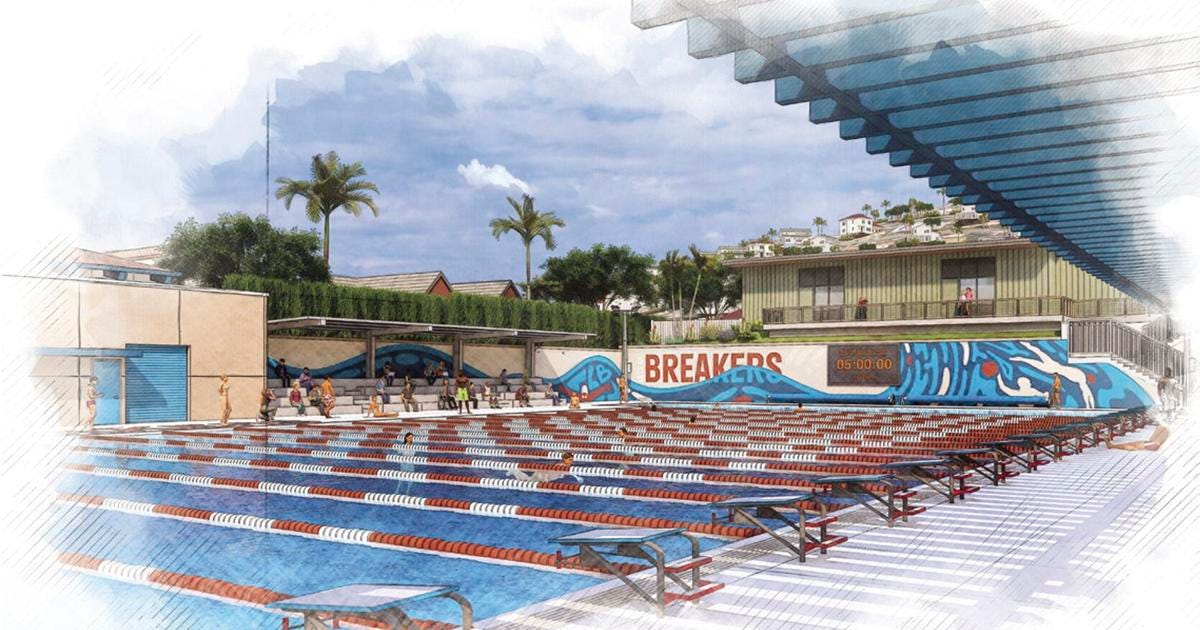
The pool has started to get talked about like it is some extra that the district decided to splurge on. That is not what this is.
LBUSD says the existing pool has reached the end of its 30-year lifespan and needs major upgrades, along with related improvements to the gym and locker rooms, to meet current standards. The district has carried the pool through work sessions, design revisions, environmental review, and formal board action as part of its long-range facilities planning. The final 2023 Facilities Master Plan update included pool modernization with a 2024 to 2027 timeline and identified cash flow requirements. The board later approved the modernization concept in October 2024, then approved construction contracts and related oversight in January 2026, with construction scheduled from June 2026 to June 2027.
The 2001 bond does not directly fund the pool. That authorization was approved in 2001, issued in the 2001 and 2003 series, and later refinanced through the 2010 and 2020 refundings. In other words, that borrowing authority had already been used for earlier generations of facility work.
But it is still part of how the district got here. By using the 2001 bond to cover earlier rounds of major capital work over time, the district did not have to cash-fund all of those earlier needs at once. That gave the district, over time, more room to build separate capital fund reserves for future facility projects. Those reserve funds are now part of the pool's support.
The reserve question
“Reserves” gets tossed around in these conversations like it ends the debate all by itself. It does not.
The cleaner way to think about it is this: the district used bond financing for earlier waves of major facilities work, and it also built reserve funds over time for future capital needs. The current pool project is being supported through those reserve and cash-transfer structures, not through leftover 2001 bond proceeds. Reporting on the January 2026 approvals said the project had about $20.4 million already allocated, including an $11 million General Fund transfer in the current fiscal year, a planned $4 million transfer in fiscal year 2026-27, and $5.4 million from the capital reserve fund.
So when someone says the pool is “draining reserves,” that is too loose to be useful on its own. The stronger version of that concern would focus on cash flow, reserve targets, and opportunity costs. Is the district using too much cash and reserve capacity on this one project, and what does that mean for the next round of major facilities needs? That is the real question.
District first, community too
LBUSD’s project materials state that the conceptual design is built around the programmatic needs of the district’s aquatic and athletic programs, while also recognizing that the pool functions as a community resource. That is the cleanest way to put it. It is a district pool first. It also has community value.
The point there is that the district is not building a city pool on behalf of the city. It is modernizing a district facility that the wider community has historically used.
As for the city, LBUSD says the Laguna Beach City Council voted on March 12, 2024, to end the joint-use agreement with the district and to pursue a separate city-operated 25-meter pool. So if the point is to be straight but fair, it is this: the city had a chance to stay in a shared arrangement and chose a different path. LBUSD then moved forward with a district-led project that still acknowledges community use, but is being designed around district needs first.
The master plan is the point
LBUSD says its Ten-Year Facilities Master Plan has been in place since 2015, is updated annually, and guides long-term planning for maintenance, renovation, modernization, and capital improvements across district facilities. The plan also notes that some projects can take about three years from planning to construction.
That is not evidence of distress. It is what a district is supposed to be doing. If anything, the worst sign would be aging facilities and no serious long-range plan behind them.
What a future bond could actually support
A future bond would not be about the current pool construction itself. It would be about the next wave of major capital work that the district’s planning process is meant to identify and sequence over time.
Based on the district’s bond history and planning framework, a future bond would most logically support the same kind of big-ticket infrastructure school bonds are typically used for: roof replacements, HVAC upgrades, electrical work, site drainage, modernization, accessibility, and safety or technology upgrades.
That is also why districts keep coming back to bonds. Even a well-maintained district is still dealing with a physical plant that ages in waves. One project gets done, another one rises on the horizon. The master plan is supposed to make that visible before it becomes an emergency.
I wish to be careful because we cannot say that a future bond is officially tied to one or two named projects in the current master plan. But what I can say with confidence is that if a future bond is proposed, it would most likely be justified around the next round of major facilities modernization and systems work, not day-to-day school operations.
What a 2026 bond would really ask
If a 2026 bond shows up, voters should be looking past the word “bond” and asking a much more practical set of questions.
Are these projects necessary?
Are they the kind of projects that make sense to finance over time?
Is the project list clear enough for voters to understand what they are approving?
Is the repayment structure reasonable?
Is the district being transparent enough about tax rate, timing, and oversight?
LBUSD’s public materials show that the district has already modeled future GO bond election scenarios and tax-rate targets. That does not mean a 2026 bond is automatic. It means the district is doing the kind of forward-looking planning districts usually do before they ever place a measure before voters.
And if the district brings forward a measure with a clear project list, a responsible repayment structure, and meaningful public oversight, that would be a standard and rational way for a school district to handle long-term capital needs.
A school bond is not automatically a good idea in every case. But pretending it is inherently a bad one is just as unserious.
Where this lands
After all the jargon, the argument is still pretty simple.
What needs to be maintained?
What still needs to be built or modernized?
What funding tools actually fit that kind of expense?
And is the district being honest enough about the needs, the costs, and the trade-offs so the public can make a clear-eyed decision?
People usually judge a district by what happens out front. The harder job is preserving the structure behind it and working over time.
The Good, the Bad, & the Boring: School Bonds

Part 1: Why even a well-funded district still needs bonds

