

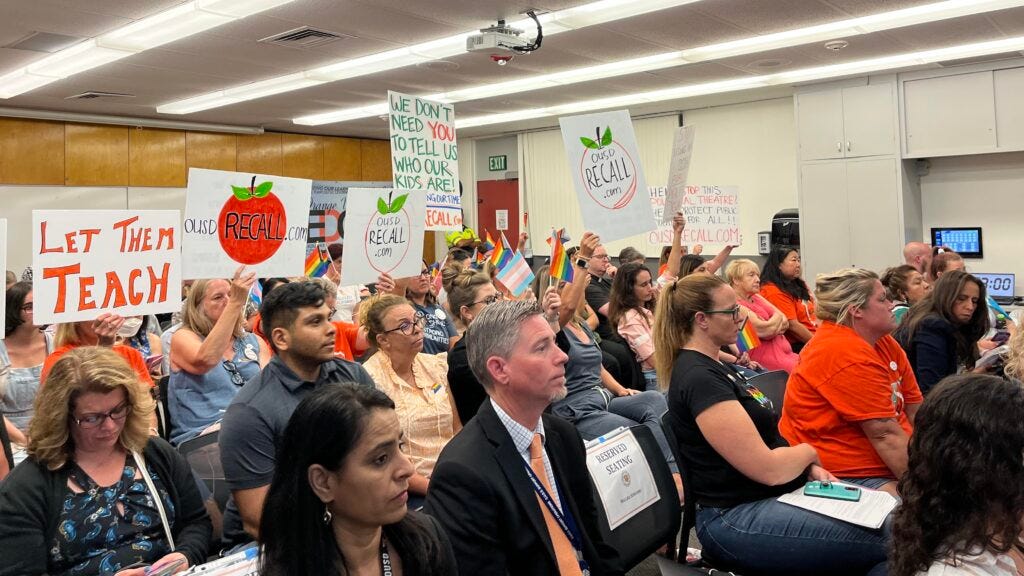
Looking back at Orange Unified now, it feels obvious. Of course, it spiraled. Of course, it ended in recalls. Of course, it became a statewide story.
But that’s only clear in hindsight.
At the time, nothing seemed dramatic. It just looked like routine procedure.
A special meeting was called over winter break. That is allowed. The board moved into closed session. Also allowed. A majority voted to terminate the superintendent without cause, which is permitted under contract and state law.
On paper, nothing out of the ordinary happened.
But in reality, everything changed.
That vote changed the way the board operated almost overnight. It showed that the majority was ready to act quickly and decisively in areas that had once felt more cooperative and stable. After that, things heated up quickly.
Not long after, the board suspended access to the district’s digital library because of a complaint about a book. This was followed by debates about parental rights and curriculum transparency. Instead of quiet talks among professionals about what students should read, these conversations were now happening in public meetings. Each decision, on its own, could be justified. Every action was technically within the board’s authority.
But together, these actions create a precedent. And precedent carries a lot of weight.
When the board steps into day-to-day operations, trust can fade. This shows why clear boundaries are needed to maintain stability.
Within a year, voters in Orange Unified removed two trustees from office.
No dramatic bylaw changes were needed. The board already had the authority. What changed was how they chose to use it.
Now bring that closer to home.
In Laguna Beach, we recently saw the board vote on where graduation would be held. That could appear trivial, but in the past, decisions about graduation logistics have been made at the school level. When the board makes decisions like venue selection, it shifts the boundary a bit.
This isn’t just a symbolic change. Graduation decisions impact contracts, staffing, accessibility, rehearsals, communication, and a lot of behind-the-scenes work that school teams have already started. When the board votes on the venue, it changes both the outcome and who is expected to make these operational decisions.
There has been talk in the community about curriculum access and book oversight. If the board starts discussing voting on books in public, that’s not a small change. It’s the kind of issue that can quickly go from a concern to something political.
Once the board starts voting on these boundaries, the incentives shift. More issues become open to votes because the precedent has been set. Facilities priorities and timelines can turn into bargaining chips. Projects might be delayed or reshuffled based on board politics rather than professional planning. Curriculum oversight can shift from reviewing frameworks to controlling content. Even individual books can end up on the agenda. No one has to act recklessly for this to happen - it’s just what occurs when governance takes over operations in public.
Leadership stability is a big reason why this matters. I want to be clear: Dr. Glass has earned the opportunity to do the job he was hired for. People can disagree on issues without destabilizing the superintendent position. When the superintendent is steady and the board focuses on governance rather than management, the district can stay focused on students.
LBUSD uses the same governance structure as Orange Unified. A majority can call a special meeting, control the agenda, adopt policies, and make personnel decisions in a closed session.
These powers aren’t unusual - they exist in almost every school district in California.
The real difference is restraint.
Boards are meant to govern by setting direction, approving budgets, and adopting policy, thereby promoting district stability and trust. Superintendents and site leaders manage daily operations, and when these roles are clear, districts function smoothly. When roles blur, even slightly, tension and instability increase, risking district cohesion.
Voting on where graduation is held might not seem like overreach. Talking about which books should be in libraries might feel like a good response. But every time the board steps into operational matters, it sets a new standard. And once a norm is set, it’s hard to go back.
The story of OUSD shows us that escalation usually happens slowly, which is why it’s so important to practice restraint before things get out of hand.
What keeps a district steady isn’t changing the bylaws; it’s having clear guardrails.
Guardrails like clear roles and transparency demonstrate how careful processes safeguard the district’s stability and trust.
Oversight serves as the board’s job. The real question is whether that oversight stays at the policy level or becomes a matter of running daily operations by majority vote.
Just because the board can vote on something doesn’t mean it should.
Orange Unified shows how fast things can change when a board majority starts using its authority more forcefully. It opened with a simple procedure and ended with recalls.
The best way to keep a district stable is to act early, before tensions grow. If you wait until things heat up, it’s much harder to bring back balance. That’s why clear guardrails and defined roles are so important to prevent problems from getting out of control.
That’s the part people often overlook.
And that is the part worth paying attention to now.
And OUSD leadership was destabilized for years following. 4 superintendents in 3 years!