
Laguna Beach Unified had a complex healthcare contribution issue that required review, correction, legal analysis, and stronger internal controls because employee contributions were not set in accordance with the collective bargaining agreements, and the district paid more than it should have under those agreements.
No one serious should pretend it is nothing, or argue the district should have ignored it. Anytime public funds are involved and agreements are not followed, people have a right to be concerned and expect accountability. But a real issue is not the same as a scandal; a compliance problem is not the same as corruption; and a benefits-administration error is not proof that teachers stole from students.
The independent review by Michael Bishop & Associates examined healthcare spending, spending variances, compliance with collective bargaining agreements, internal controls, and recommendations for correction. It identified contribution issues that needed to be addressed, but the conclusion on whether the lack of compliance constituted impropriety required legal review, which was not part of their final recommendations.
Howard did not stay in his lane.
He took the issue and turned it into the thing he had been waiting for. It became proof, at least in his mind, of problems with staff oversight, union involvement, prior board leadership, and district communications.
And when the facts were not enough to create the level of outrage he wanted, Howard built the outrage himself.
He did not just ask questions in public, review the audit, and follow protocol. He wrote the frame, paid to push it, praised those repeating it, complained that the press was not buying it, and then wrote that the group needed unofficial press coordination on the issue.
Howard can call critics “illiterate” if he wants, but the First Amendment is not hard to understand. He has the right to speak, write, criticize, buy ads, and argue his version of events as loudly as he wants. But constitutional protection is not the same thing as ethical conduct, and having the right to do something does not mean a sitting trustee should use paid ads, outside messengers, and unofficial press coordination to pressure the district he was elected to govern.
The story is no longer simply about the healthcare issue; it is about what Howard did with it.
Start with the number because it was the hook.
Howard keeps using $1.77 million because it sounds like a scandal and is big enough to scare people before they understand what actually happened. But according to the independent audit and the district’s board documents, the corrective action number the district proceeded with was about $1.04 million. Spread across the years at issue, that comes to roughly $173k per year. Against about $87.5 million in planned annual spending, that is about 0.2% of one year’s spending.
While that is not nothing, it is also not the district-defining financial collapse Howard needed it to be.
At the December 16, 2025 meeting, the district reported a cumulative overpayment of $1.04 million, and the superintendent recommended that the district absorb it from district funds. The presentation also made it clear that the option would not affect employees or claw anything back from them. The board accepted that corrective-action path. For the community, that should have narrowed the issue to implementation, controls, and preventing the error from happening again.
But for Howard, closure was never useful. The useful outcome was leverage.
One of the most dishonest parts of this whole thing is how Howard’s narrative keeps returning to our teachers and staff, even though they did not set the rates, design the contribution structure, or decide how the district administered those benefits.
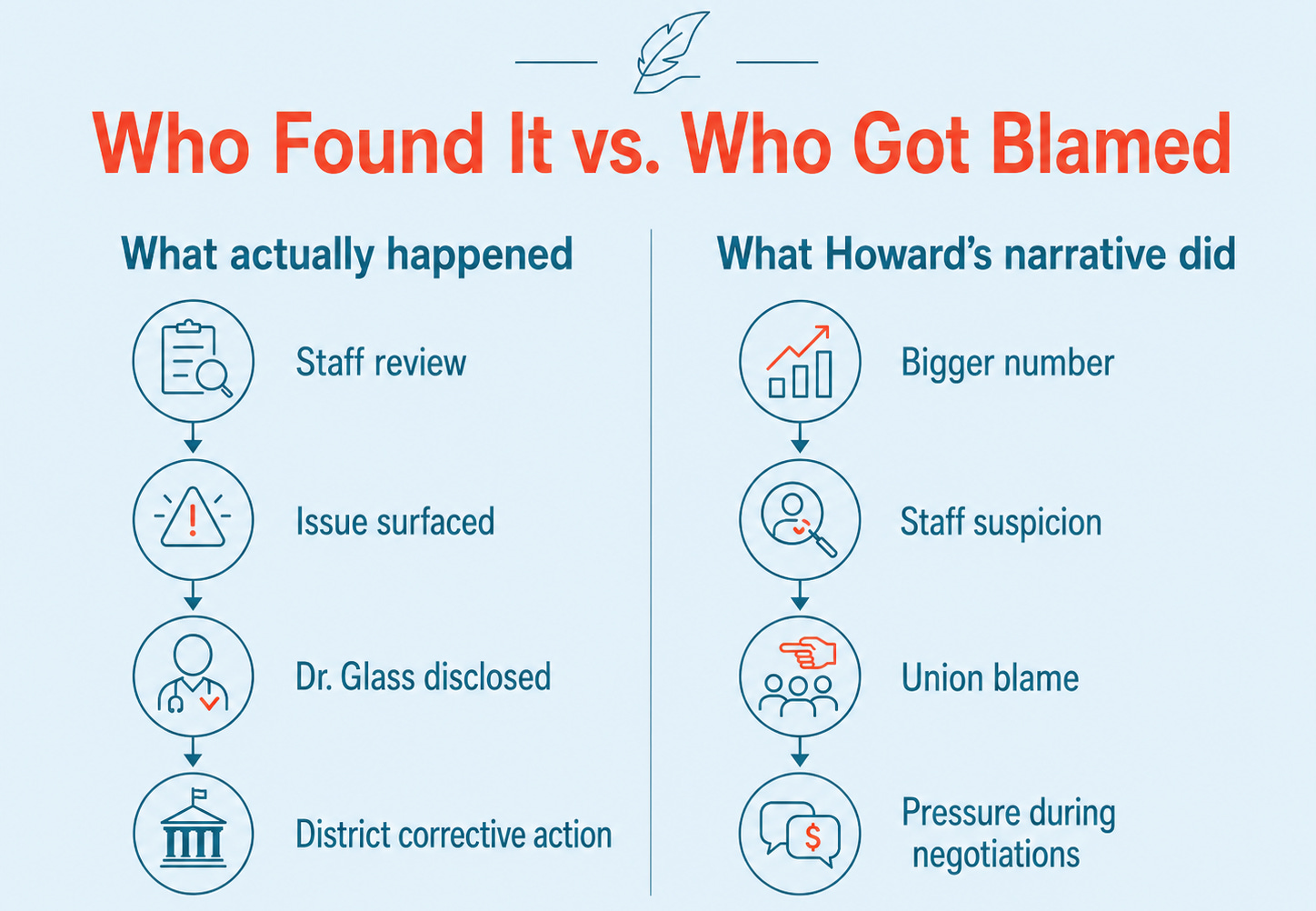
Howard was not the one who uncovered a secret scheme. The issue came to light through district review, staff questions, and Dr. Glass’ public disclosure, meaning the people Howard’s narrative blames were part of the system that first surfaced the problem.
A responsible board member could have said that the district found an issue, that the district needs to correct it, that employees should not be punished for a district-administered error, and that stronger controls are needed in the future.
Howard chose something else.
He kept pressing, kept escalating, kept using the bigger number, and kept aiming the story toward staff, unions, former board members, and anyone connected to the version of LBUSD he had already decided was broken.
Once Howard decided he had found something rotten, corrupt, and intentional, everything else had to bend around it. If staff explained the issue carefully, they were spinning. If Dr. Glass stayed within lawful and process boundaries, he was protecting the “broken” system. If the audit did not go as far as Howard wanted, he went further anyway. If the accurate number was less useful than the inflated one, he kept using the bigger one. If employees did nothing wrong, they still became part of the story.
That is not oversight. It is an obsession with a target.
Howard did not need the district to fix the problem as much as he needed the district to validate his version of the problem, and when Dr. Glass would not do that, the relationship shifted.
Howard’s posture toward Dr. Glass only worked while Howard believed Glass might become useful to him, useful in taking apart the old story of LBUSD, validating Howard’s theory that the district was broken, and turning a compliance issue into the public prosecution Howard had wanted.
But Dr. Glass kept pulling the discussion back to process, law, role clarity, legal review, and actual governance. Howard wanted the district to validate the board majority’s theory of control. Dr. Glass would not turn staff into villains just because Howard needed villains. He would not turn district communications into Howard’s personal press shop, nor take a real issue and inflate it into the scandal Howard had already decided it was.
Once that became clear, the posturing faded.
When Dr. Glass’ separation was announced, Howard did not seem like a trustee grieving another destabilizing leadership change in a district that had already been through too much. He looked like someone who believed he had won.
That moment stayed with me because Howard did not need Dr. Glass to fix LBUSD; he needed Dr. Glass to support his goal in taking the district apart in the name of saving it.
Healthcare became the biggest weapon, but it was not the first sign of the pattern. By early 2026, the same majority dynamics were emerging around agenda control, public comment placement, governance processes, and operational decisions that staff and site leaders should have handled.
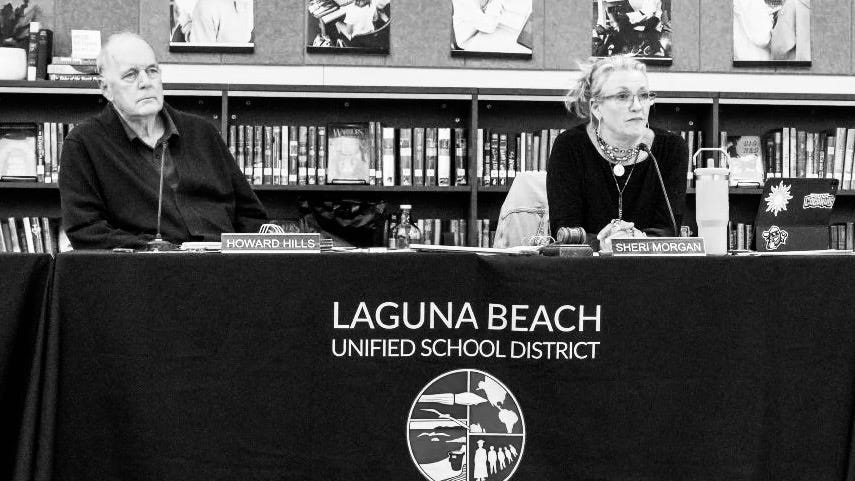
The voting records show repeated 3-2 splits in which Hills, Morgan, and Perry formed the majority, including the January 22, 2026 vote granting the board president final approval to post and propose the agenda for the board’s adoption.
Howard pushes, Sheri aligns, Dee makes it a majority, and then the public is told this is just governance.
But governance is not the same thing as control, and oversight is not the same thing as trying to run the district from the dais.
By April, Howard’s own words connected the pieces.

In an email titled “CONFIDENTIAL: Unofficial Communications Management,” Howard wrote to Sheri Morgan, Steve McIntosh, George Weiss, Kate McMahon, and Michele Monda about the frustration of not convincing the press, Steve’s op-eds, the full-page ads, and the need for someone “coordinating press.” He also said that even if the district obtained official communications support, they still needed a community-based team to manage issues with the unofficial press.
That is not a random community concern. It is a sitting trustee discussing an unofficial communications operation around district business, with the board president and outside allies included.
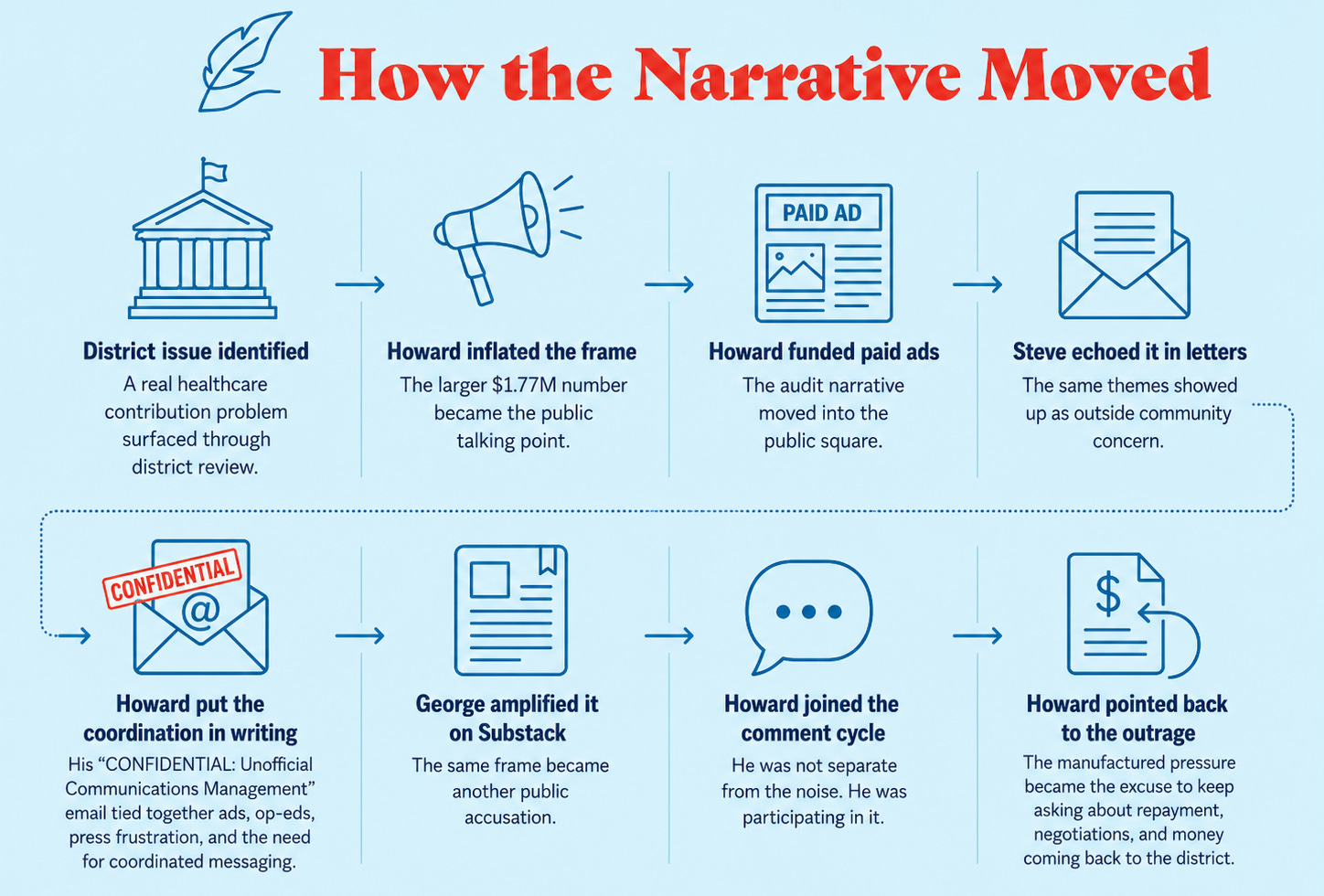
It also explains why the same story kept showing up everywhere. Howard funds the ads in the Indy, Steve writes the letters, George boosts the claims, the public hears the same accusations from multiple directions, and Howard then points back to the noise as if it proves the community is demanding answers.
But the noise did not come from nowhere. Howard built it.
Sensible Laguna (founded by Gary Kasik, Steve McIntosh, and Steve Brown) endorsed Howard, and Steve McIntosh later became one of the outside messengers Howard praised by name. George Weiss amplified the same claims on Substack. Howard’s paid advertisements are part of that record, too. They were not neutral civic updates. They were full-page ads under the FUTURE banner that praised the new board majority, attacked FUEL, criticized district leadership, repeated claims about healthcare overpayments, and blurred the line between Howard as a private advocate and Howard as an elected trustee.
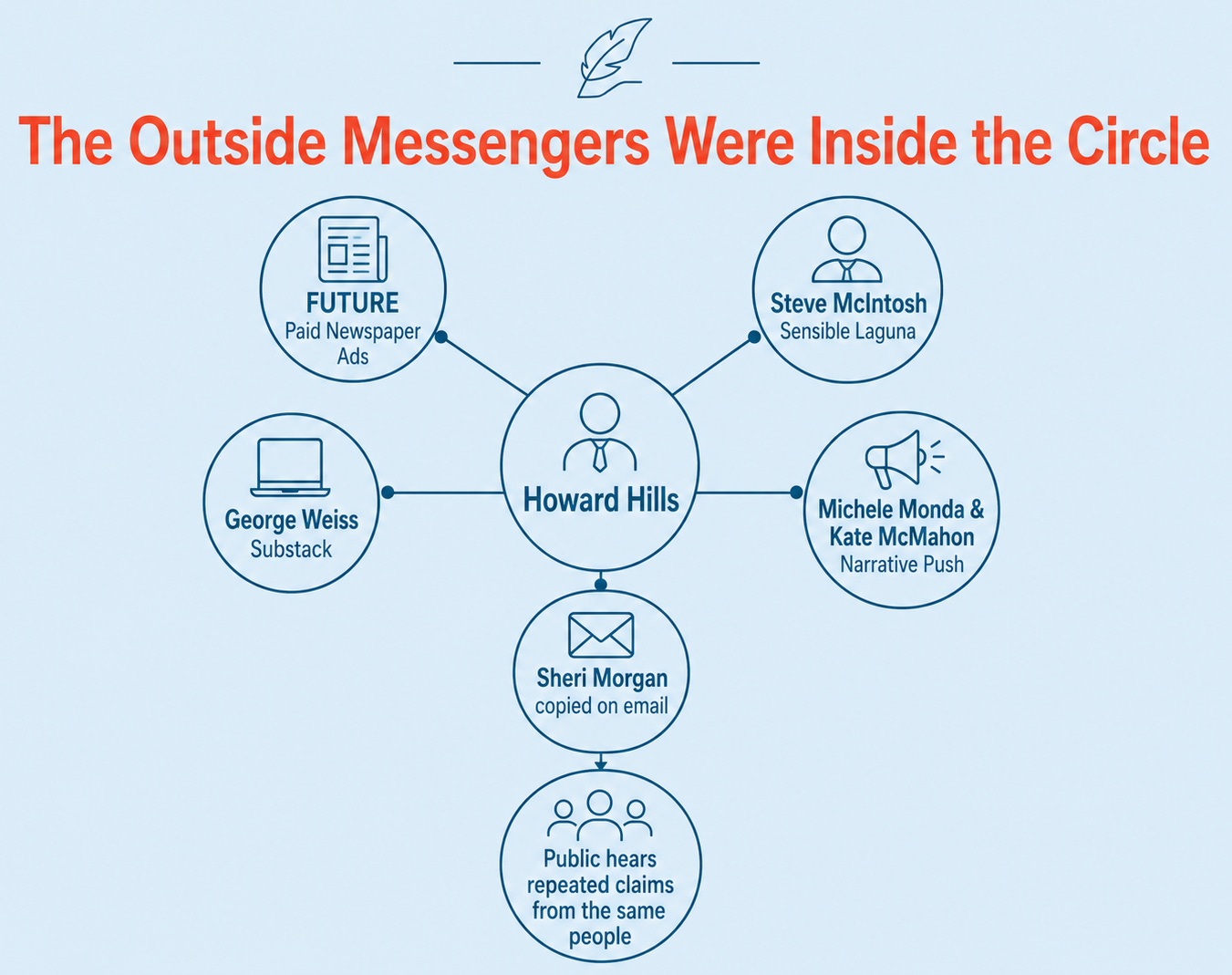
And the people accusing everyone else of bias were standing awfully close to Howard’s own messaging machine.
That does not mean every person who agreed with Howard was directed by him, nor does it mean community members cannot write letters, publish posts, support candidates, or criticize the district. Of course they can. But when a sitting trustee names the op-eds, ads, and people, complains about the press, and asks for someone to coordinate communications, the public can ask whether the outrage came first or whether Howard built it himself.
I want to be clear about my own role in this. No one told me to start writing about LBUSD, no board member feeds me materials, and I am not taking direction from FUEL or any other organization. I started paying closer attention because of Howard’s conduct, and use sources such as public records, board materials, meeting videos, public comments, contracts, filings, and my own experience as a parent watching this district.
That is the distinction Howard’s side keeps trying to erase. Parents talking to each other is not the same thing as a trustee building a communications loop. Community members reading public records is not the same thing as an elected official feeding a narrative through ads, letters, Substack posts, and then pointing back to the noise as proof of public demand.
For all of this work and claims that “the community” is demanding this crusade continue, it keeps coming back to the same small circle of people repeating the same claims in the same places. The fact that the campaign has not caught fire as Howard clearly wanted would almost be funny if the consequences were not falling on teachers and staff.
The outrage campaign may not be persuading the broader community, but it is still landing on the people inside the district who have to work under it every day. The constant focus on this issue, the suspicion directed at teachers and staff, and the loss of trust in district leadership create an atmosphere that trickles down into classrooms. Students are affected when morale is low, and teachers and staff are distracted by controversy rather than fully supported in their day-to-day work.
And Howard’s fixation is not just rhetorical when bargaining is on the table.
His April email suggested that, with or without action by the DA, the county, or the state, the board had a fiduciary duty to address the audit with senior district staff and unions in the current CBA negotiations. He also framed the negotiations as being exploited by unions and supporters of former board members defeated in 2024.
When Howard keeps pressing who benefited, what was paid, and whether the district can recover money, he is not asking neutral questions in a vacuum. He is doing it while COLA (cost-of-living adjustment) and compensation are active or imminent, as employees face rising costs, and as Laguna’s teachers and staff absorb months of public suspicion created by a trustee who cannot separate a district-administered error from employee wrongdoing.
If the district has already decided employees do not need to pay for an error they did not create, that principle should not quietly reappear at the bargaining table as pressure on COLA, salary, or future benefits.
In addition to that, the claim that parents, teachers, and staff are simply manufacturing outrage collapses when you look at what staff were already saying before the email became public.
In the March 2026 staff listening sessions with Glass and Sheri Morgan, employees identified governance dynamics and the atmosphere of public board proceedings as barriers affecting campus climate and morale, as well as erosion of trust and psychological safety, communication shortcomings, staffing pressures, and questions about the boundary between governance and site operations.
This is not only about Howard, even though he is the loudest and most committed to the idea that he uncovered corruption. Sheri Morgan was on the unofficial communications email. While that does not prove she wrote the ads or directed outside messengers, it shows she was included in discussions about press frustration, op-eds, full-page ads, and the call for coordinated press coverage.
Her broader approach has followed the same instinct: question communications, staff authority, processes, and assess whether fear is coming from within, all while pulling more power toward the board majority.
Dee’s role is different, but Dee is the vote that turns Howard and Sheri’s instincts into board action. Howard pushes, Sheri aligns, Dee makes it a majority, and then the public is told this is just governance. Even when the technical defense is that only two trustees were communicating in the April email, the public concern remains the same: where is district business actually being shaped, at the dais or through side channels?
But the district is not one trustee, one board president, or three votes.
The district includes students, teachers, staff, administrators, families, and the community that supports them.
Howard keeps revealing the same thing: he does not seem to understand the difference between serving the district and trying to make the district serve him.
He can call it transparency, accountability, or fiscal responsibility, but the record shows something much uglier. He took a district-administered error, inflated it into a public scandal, aimed it at employees who did not create it, and used outside messengers to keep the pressure alive while negotiations sat in the background.
That is not oversight. That is not ethics. That is not courage. It is Howard turning a real issue into his proof, his platform, and his power play.
The healthcare issue was real, and the correction was necessary, but Howard’s campaign around it is the story now, and LBUSD should stop treating his fixation as governance.
Howard Hills was not elected to be the district.
He was elected to serve it.
Sources:
LBUSD Health & Welfare Overpayment Corrective Actions presentation
Howard Hills / FUTURE paid advertisement in Laguna Beach Independent
A Public Record for Laguna Schools provides independent, community-focused coverage of LBUSD to help make district decisions, public records, board actions, and issues easier to follow. If you value this work, becoming a paid subscriber or patron helps make it sustainable by covering the research, writing, and platform costs that keep this information accessible to everyone. I am deeply grateful to anyone who reads, shares, subscribes, or supports this work in any way.
Your calm and clear-headed analysis of Howard Hills is spot-on.
Thank you so much the latest email discovery by Howard is so reprehensible it is almost unbelievable but unfortunately it is true and staff is tired of his tirade and lies and accusations. It needs to stop and he needs to be held accountable.