

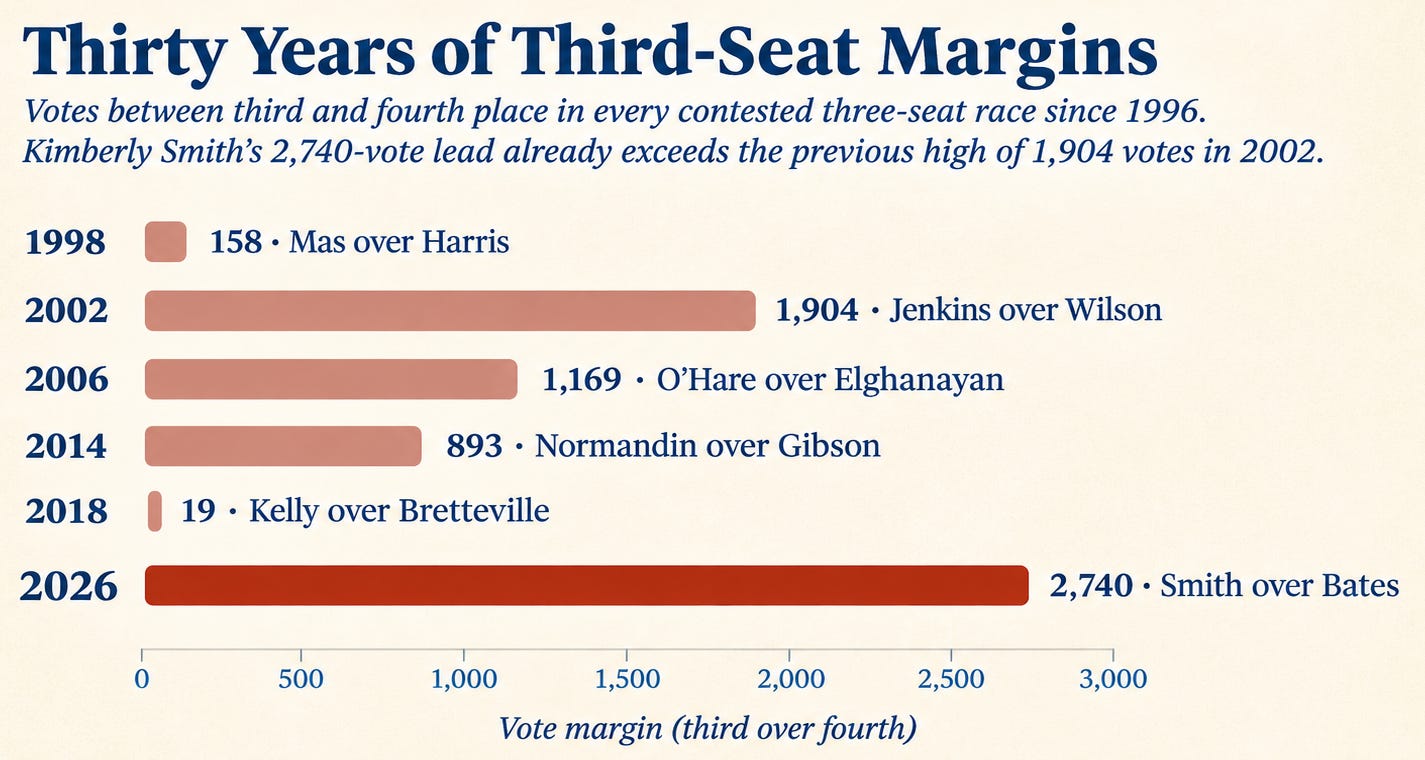
In 2018, just 19 votes separated the candidates finishing third and fourth in the Laguna Beach Unified School District Board election. In 2024, the final seat was decided by 213 votes.
As of November 6, 2026, Kimberly Smith leads Liz Bates by 2,740 votes, with thousands of ballots still to be counted.
I have spent much of the past two years following our School Board and was curious how these results compared with previous elections. After digging through 30 years of election returns, I found some rather cool numbers.
Between 1996 and 2024, 17 incumbents sought reelection across 12 contested LBUSD School Board elections. Fifteen won, with only two defeats belonging to the same person: Jan Vickers, in 1996 and again in 2024.
No incumbent finished last among the candidates in those elections.
Dee Perry, first elected in 2014, reelected in 2018, and appointed in 2022, is currently sitting in fifth place out of five candidates.
After thirty years of election history, Dee is approaching a distinction no incumbent in that period has held.

As of Orange County Registrar’s November 6 count, Joan Malczewski leads with 6,820 votes, followed by Shaheen Sheik-Sadhal with 6,436 and Kimberly Smith with 6,284. Liz Bates has received 3,544 votes, while Dee has 3,362.
Voters can select up to three candidates, so the most useful historical comparison is the percentage of district ballots on which each candidate appears. Joan is 55.1%, Shaheen 52.0%, and Kimberly 50.8%, compared with 28.7% for Liz and 27.2% for Dee.
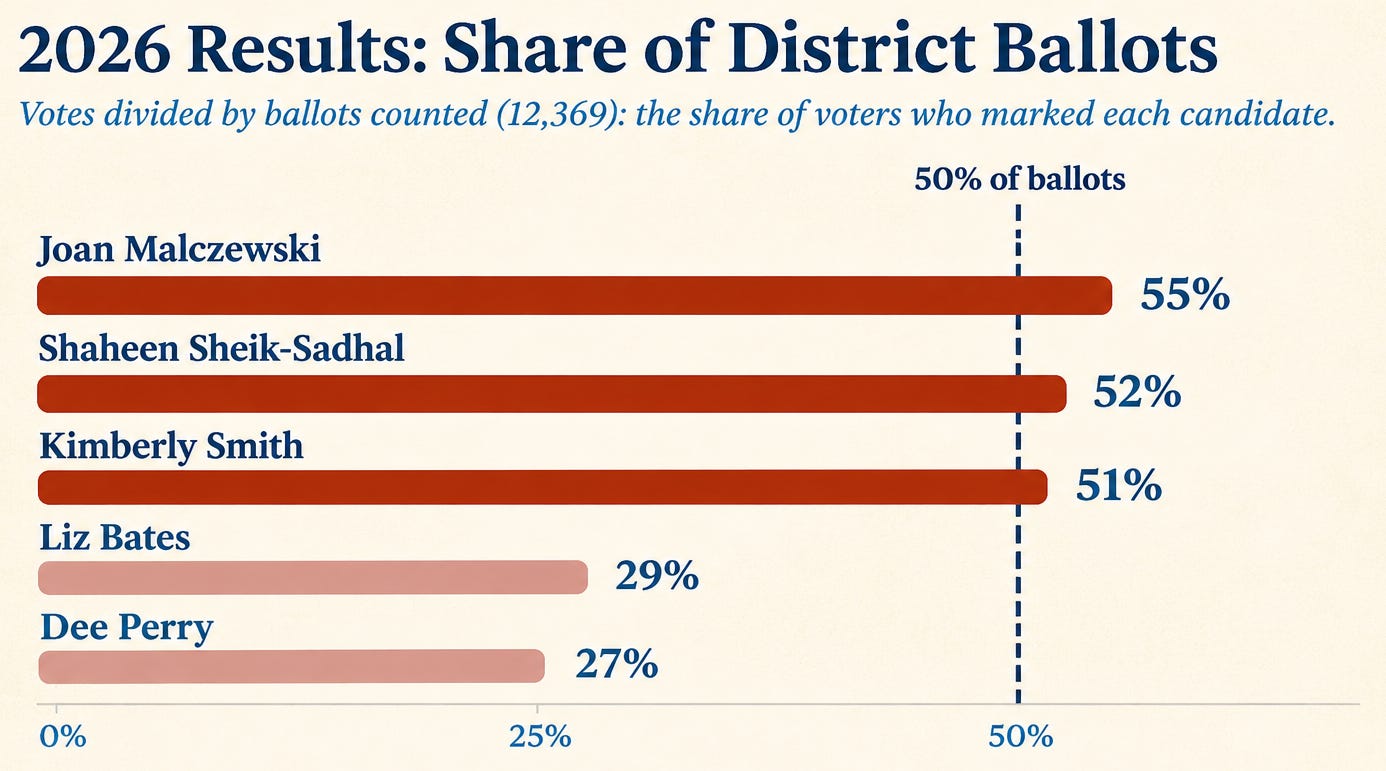
All three candidates supported by Families Unified for Education in Laguna (FUEL) are appearing on more than half of the district’s ballots.
In previous contested three-seat elections since 1998, no election had all three winning candidates exceed 50%. In fact, no candidate crossed that threshold in 1996 or 1998.
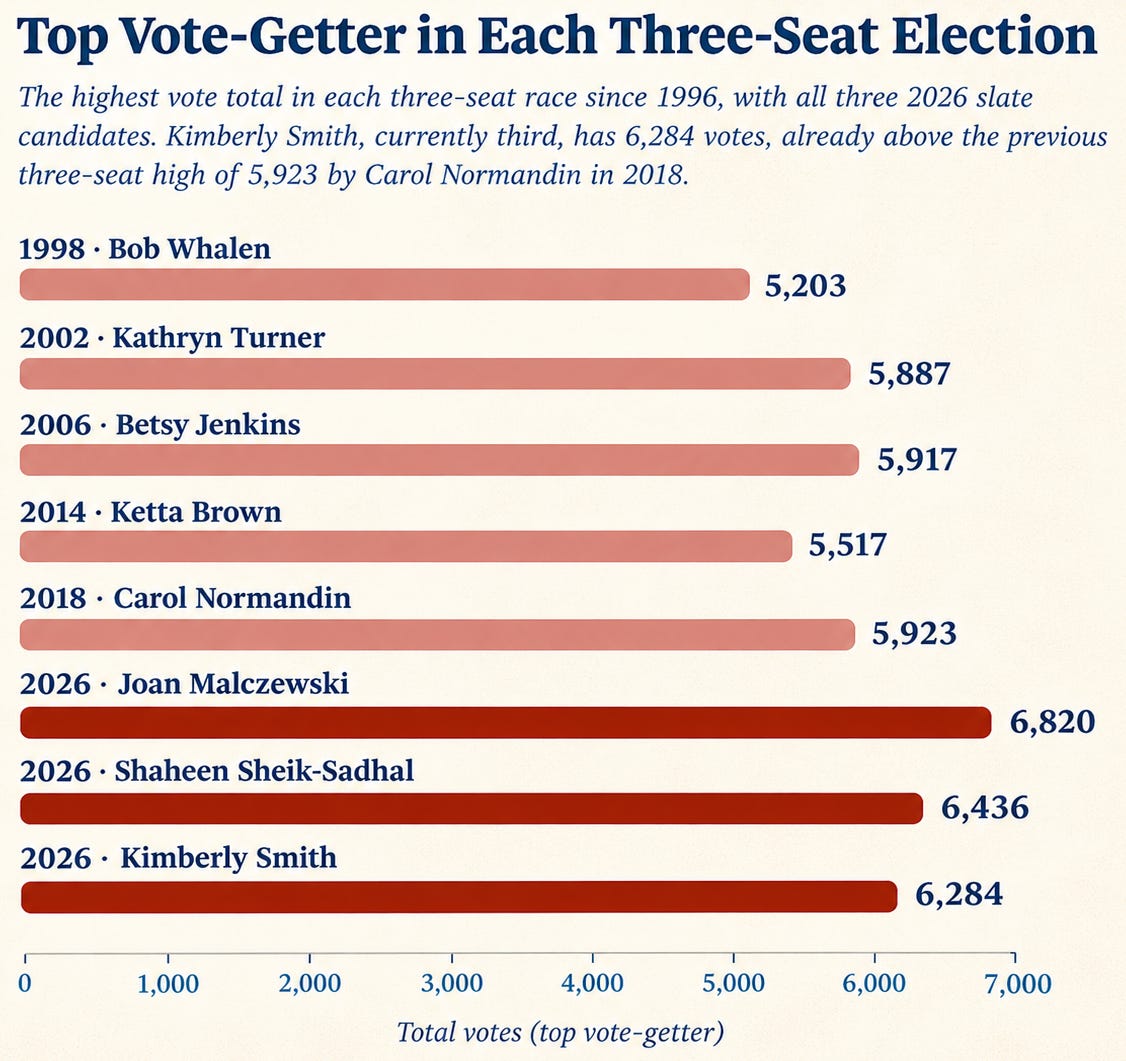
The raw vote totals are equally remarkable. Across five previous contested three-seat elections since 1996, Carol Normandin had the highest individual total: 5,923 votes in 2018. Joan, Shaheen, and Kimberly have already surpassed that number, even with counting still underway.
The margin between Kimberly and Liz is the largest third-seat margin in the last 30 years. The previous record was 1,904 votes in 2002, when Betsy Jenkins defeated Thomas Wilson for the final seat. Kimberly’s current lead exceeds that margin by 836 votes.
Jan Vickers holds another historical distinction, receiving 9,546 votes in 2004, the highest individual vote total in the records I reviewed. Her name appeared on 55.25% of district ballots, compared with Joan’s current 55.14%.
For anyone wondering, we are now comparing school board elections down to tenths and hundredths of a percentage point.
For nearly two years, the parents who organized FUEL were characterized by some critics as a loud, disruptive minority whose concerns were supposedly shared by very few outside their circle. That characterization becomes harder to maintain when the three candidates they supported are receiving this level of support across the district.
The way voters used their ballots offers another interesting comparison. In 2018, the last election with three seats available, voters selected an average of 1.66 candidates per ballot. The previous high in comparable three-seat elections with verified totals was 1.87 in 2002.
This year, voters are selecting 2.14 candidates per ballot, using about 71% of their available votes.
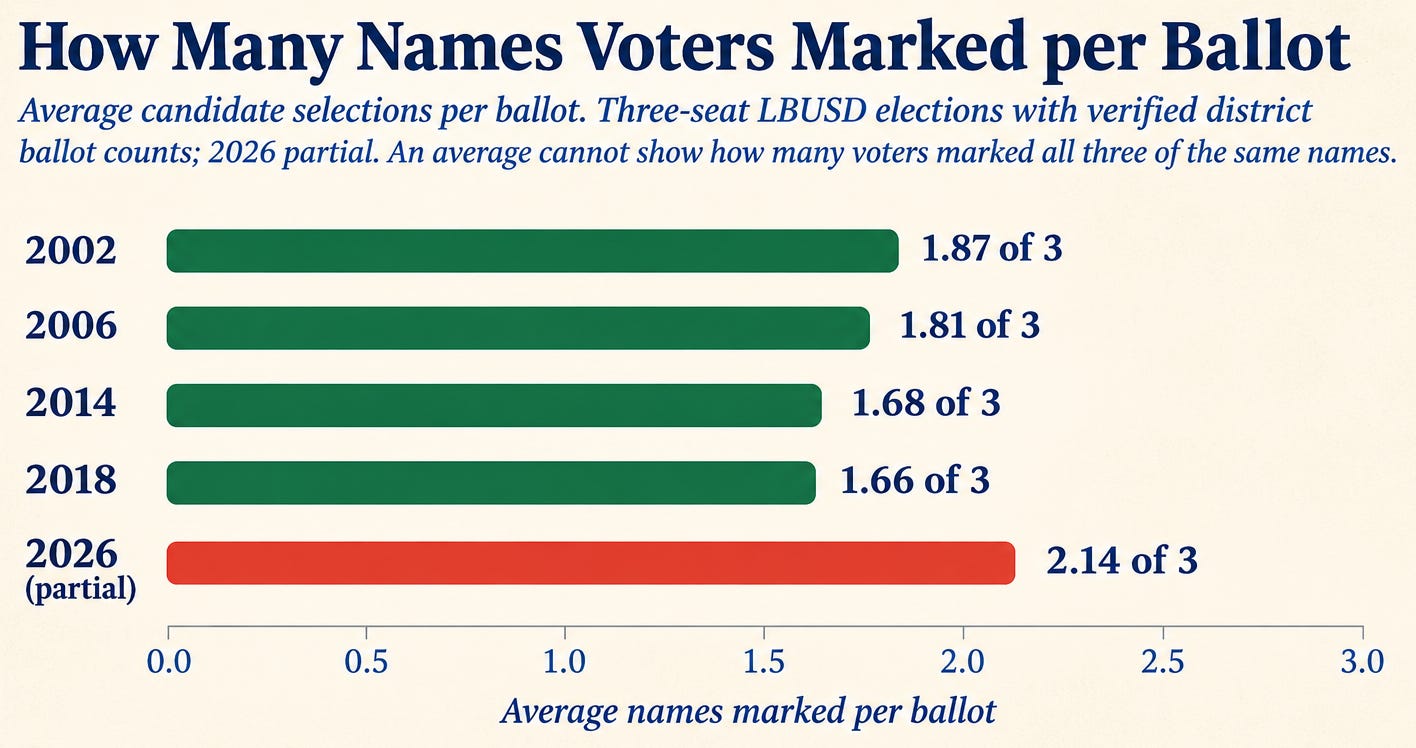
The two slates approached those three choices differently. Joan, Shaheen, and Kimberly consistently encouraged voters to select all three names, while Dee and Liz asked supporters to vote only for the two of them and leave the third blank.
Apparently, quite a few Laguna voters found a use for that third oval.
Only 536 votes separate Joan from Kimberly, suggesting substantial consistency in support across the three-person slate, although the returns cannot show exactly how many voters selected all three together.
The “Just Support Kids” campaign supported its three-name message through months of community outreach, neighborhood letters, yard signs, gatherings, conversations, and volunteers showing up throughout the district. What began with a handful of concerned parents ultimately attracted families, retirees, students, business owners, and residents who had never been involved in a political campaign before.
Teachers and classified staff made their positions equally clear. Every participating teacher in their union’s endorsement vote supported Joan, Shaheen, and Kimberly, while 98% of participating classified staff supported the same three candidates. All five Laguna Beach City Council members also endorsed them.
The community members who supported the movement extended across political affiliations, generations, neighborhoods, and households with and without children in our schools. The scale of the public-facing campaign was unusual for a local School Board race, and the election results truly show the support for Joan, Shaheen, and Kimberly.
The number of candidate votes is approaching another historical record.
As of November 6, the Registrar has counted 12,369 district ballots containing 26,446 candidate votes. That is just 647 short of the highest total recorded in any School Board election since 1996, when voters cast 27,093 candidate votes in 2020.
Of course, voters could select two candidates in 2020 and three in 2026, so the comparison represents both participation and how many names voters marked.
At 16,000 district ballots and the current average of 2.14 selections per ballot, the election would generate about 34,200 candidate votes, substantially exceeding the previous total. That calculation assumes the remaining ballots follow the same pattern, while final turnout remains unknown.
Joan would also need approximately 17,315 total district ballots at her current share to surpass Jan’s 2004 record of 9,546 individual votes. With more than 18,000 district ballots cast in 2024, this is another historical benchmark worth tracking.
For me, though, these numbers are only part of the story.
The parents who organized FUEL faced repeated accusations of being disruptive, politically motivated, and unrepresentative of the wider community. They continued attending meetings, asking questions, examining public records, and speaking with neighbors, even as criticism became increasingly personal.
The criticism focused on parents and students became particularly ugly in the final weeks before the election.
On October 16, Howard circulated an email featuring photographs of children from the May 14 protest, associating them with School Board candidates and using those images to criticize FUEL.
Then Dee published a paid political advertisement featuring photographs of two children belonging to Iva Pawling, a parent who had openly criticized Dee and the Board majority.
Their faces were blurred, but Iva’s eight- and thirteen-year-old children were recognizable to people within the community. Iva said she had not authorized the use of their images and publicly confronted Dee at the October 22 School Board meeting.
Dee responded that she was “not trying to shame them.” No apology came during that exchange.
I found that decision deeply troubling, especially from a retired teacher and sitting trustee responsible for governing the schools those children attend. The campaign could have criticized the protest, signs, and adults involved without using recognizable children in a political advertisement.
The parents involved in FUEL had families, careers, and responsibilities long before attending School Board meetings, organizing neighbors, and learning more about local elections than most expected.
They continued showing up despite criticism, and what began as a small group of concerned families grew into a communitywide effort supported by educators, staff, parents, grandparents, and longtime residents.
Voters have their own reasons for supporting individual candidates, and an election cannot establish agreement with every position FUEL took. Joan, Shaheen, and Kimberly brought their own qualifications, relationships, and concepts to the campaign.
Still, the results offer a compelling response to the repeated portrayal of these parents as a small, isolated group disconnected from the community.
For the parents who spent nearly two years being questioned, criticized, and personally attacked for speaking up, these results should offer a considerable feeling of vindication. They brought their concerns to the community, built an organization around them, and helped support three candidates who are now receiving some of the strongest electoral support in the district’s recent history.
If these results hold, Joan, Shaheen, and Kimberly will inherit incredible community backing and considerable responsibility. They must rebuild trust with teachers, staff, and families and restore productive governance. I fully intend to hold them to the same standards of transparency and accountability I have expected from the current majority.
Laguna Beach is a community with strong opinions, long memories, and people who are rarely shy about sharing either. We can disagree about the decisions made over the past two years and what the next Board has to prioritize, but the historical election record gives us a remarkable picture of the community’s response.
For nearly two years, these parents were told they represented a loud minority. Apparently, Laguna had some thoughts about that.
Sources:
Orange County Registrar of Voters, November 6, 2026, 4:48 p.m. unofficial results
Official Statements of Votes and historical election results, 2000–2024
California Elections Data Archive, county-supplied local election returns, 1996–1998
LBUSD October 22, 2026 Board meeting record