

After everything that has happened in our school district over the past few months, it is worth revisiting where this all began: the current board majority’s first superintendent transition.
Some may point to November 21, 2024, when the old board approved Jason Viloria’s separation agreement, as the start of that transition, but really the roots go back much further.
The transition began during the 2024 school board election campaign, through public comments, debates over the pool, and repeated claims that Laguna Beach Unified had become too closed off, too administration-driven, and too dismissive of community input.
By the November election, LBUSD was already in a political trust fight. It was not just about the pool, academic data, bylaws, public comment, or even the superintendent. It was about whether the community trusted the district’s leadership structure at all.
Sheri Morgan and Howard Hills ran against that structure. Morgan argued LBUSD had become too top-down, transparency was at an all-time low, and the old board had adopted a weak-board posture. Hills spent years criticizing LBUSD governance, legal interpretations, bylaws, understanding of the Brown Act, and the balance of power between the board and administration. Their message was simple: LBUSD’s governing culture was broken.
At the center of that debate was Superintendent Jason Viloria. Supporters saw him as a stabilizing leader with strong district outcomes; critics saw him as the symbol of an administration-led system that had become too insulated from community concerns. By 2024, criticism of district governance and of Viloria had become closely linked, allowing the conflict to build over time. At the March 14 board meeting, Sensible Laguna co-founder Steve McIntosh criticized district messaging, cited academic data to argue LBUSD was failing students, and spoke of recalling the board, taking back the district, cleaning house, and making a change at the top. The pool controversy then became the clearest symbol of whether the district was listening.
Speakers accused leadership of refusing to compromise, while Morgan tied the issue directly to district leadership and argued it was time for change.
Other disputes included facilities planning, community distrust, and student-related controversies, which were folded into the same broader narrative. By September, the divide was clear: supporters framed the pool as an investment in students and families, while critics focused on cost, transparency, and responsiveness.
So when people describe the superintendent separation as something that suddenly appeared after the election, they skip the very obvious context. The campaign was not only about policy disagreements; it was about replacing a governing culture.
Morgan and Hills won, joining Dee Perry to form a new 3–2 majority. Before the new board was seated, the outgoing board acted.
On November 21, LBUSD board members voted 5–0 to enter into a separation agreement with Viloria, ending his contract effective December 31. The district later said the decision was not based on performance and was intended to minimize disruption while allowing the incoming board to select leadership aligned with its vision.
Was it elegant? No. Was the timing fair game for criticism? Sure
But the cartoon villain version of November leaves out the reality of what was coming. For Viloria, the main target of Morgan and Hill’s campaign, having him stay on so the new majority could spend its first weeks humiliating him or firing him publicly would not have made the district more transparent. It would have made the district uglier, more unstable, and more personal.
So really, the outgoing board gave the incoming majority the leadership opening it had campaigned for. It removed the superintendent who had become the center of the political fight, avoided an immediate public firing battle, created a vacancy, and gave the incoming board the power to appoint an interim, run a search, and hire a superintendent aligned with its vision.
The majority keeps describing November as the thing done to them, but November handed them the opening they wanted.
The real story is what they did with it.
For context, a superintendent’s departure has two tracks: the temporary leadership bridge and the permanent superintendent search. A permanent search is supposed to create legitimacy. It should show the community that the board did not start with a preferred candidate and work backward.
An interim appointment is different because a district cannot sit around for months waiting for a permanent search to finish. Payroll, contracts, board agendas, staff direction, family communication, and daily operations still have to happen. That is why districts often appoint an internal acting superintendent first: someone already inside the system who can keep the district functioning. At the same time, the board develops the long-term plan.
But “interim” does not mean “anything goes.” Even a fast process should be clean. The board should identify the need, decide whether it wants an internal acting superintendent or outside interim, give trustees equal information, discuss candidates only after the process is clear, report out any action, and bring any employment agreement back in open session. A good interim process calms the district.
The new LBUSD board majority did the opposite.
The November 21 decision has also been criticized as a possible violation of California’s newer superintendent protections, but that argument overlooks timing. Education Code § 35150 applies after the first convening of the newly elected board. On November 21, Morgan and Hills had not yet been seated, and the new board had not convened.
A more specific concern involves reporting procedures. The open session began with “no report out of closed session,” yet it was announced later that there was a 5–0 vote to separate from Viloria. While the later written report was the legal minimum, questions about the process are reasonable. November was politically contentious and imperfectly handled, but it was not the event that most clearly tested the new majority’s governance approach — that came on December 16.
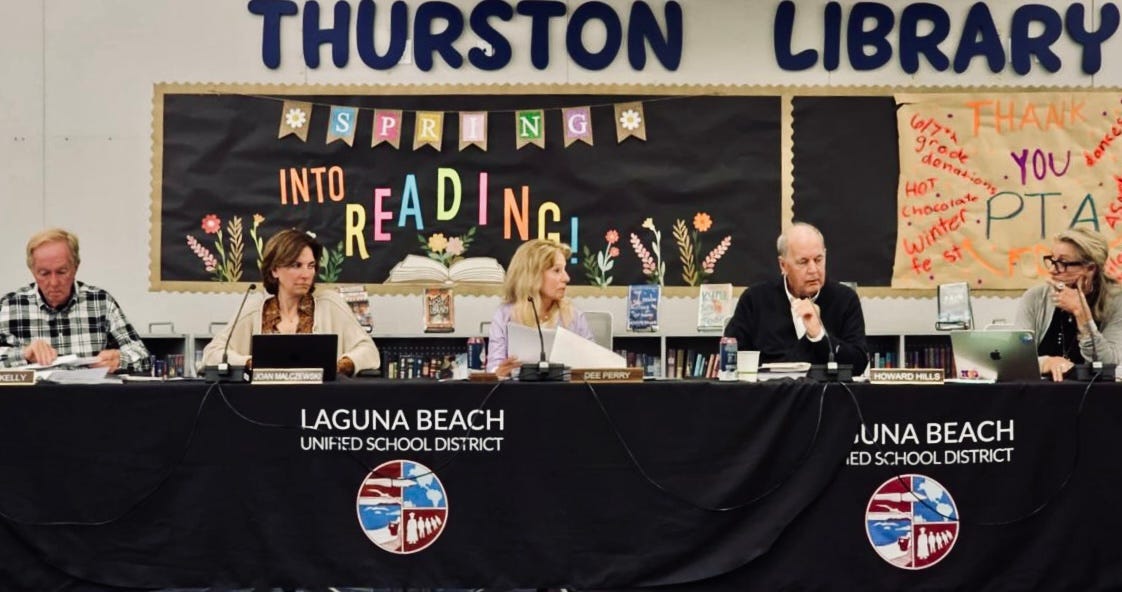
It was Morgan and Hills’s first meeting as trustees and the first major leadership decision facing the new board. Viloria’s departure was already scheduled for December 31, and the agenda included discussion of the interim superintendent process.
Rather than discuss the process publicly first, Hills immediately moved to advance closed session ahead of that discussion. Trustee Joan Malczewski objected, arguing that the board had not yet publicly addressed basic questions: whether it wanted an internal acting superintendent or outside interim, how candidates would be considered, what criteria would apply, or whether the interim could seek the permanent position.
Hills argued the board needed to move forward with appointing an interim superintendent, and Morgan attempted to cite legal authority for the closed-session discussion. But the disagreement was less about legality than process. People argued that transparency required the board to establish and discuss the process before considering candidates.
Malczewski then raised concerns that potential candidates had already been contacted before any public process had been discussed. Trustee Jim Kelly also objected, noting that moving the closed session forward delayed public comment. The motion nevertheless passed 3–2, with Morgan, Hills, and Perry voting yes and Kelly and Malczewski voting no.
After the closed session, the board reported a 3–2 vote directing the preparation of an employment agreement with Dr. Joanne Culverhouse as interim superintendent, effective January 1.
Culverhouse’s qualifications were not the central issue; the controversy centered on process. Kelly said he did not know Culverhouse and felt the board had been presented with a preferred candidate. Malczewski said she expected a discussion of the process first and would have preferred multiple candidates or, at least, broader board review.
Again, the board did not need a full permanent search to appoint an interim, but it did need a clean process. Instead, the majority started with a person and worked backward.
Then Culverhouse withdrew. The public record does not tell us her private reasoning, but the public effect was clear: she did not become the face of a process that had already lost legitimacy. From the outside, stepping away looked like the integrity move.
The majority moved quickly, split the board, and failed to make an appointment. The district still needed leadership.
On January 9, the board unanimously appointed Dr. Jeff Dixon as acting superintendent. Dixon was already serving within the district and provided an immediate operational bridge while the board prepared for a permanent search.
By January 23, speakers cited more than 70 written comments in support of Dixon and described him as qualified, respected, and trusted. The interim leadership question had largely been resolved, but the December controversy continued to shape perceptions of the superintendent search.
Leadership Associates became part of that discussion because of Culverhouse’s affiliation with the firm. Questions persisted about who had been contacted, when conversations occurred, and whether the board had followed a shared process or begun with a preferred outcome.
As the permanent search moved forward, Malczewski emphasized that community acceptance and trust would be essential. By March 2025, the district was gathering input, extending surveys, and hosting community sessions, all steps intended to build legitimacy for the eventual selection.
The distinction between November and December matters because it shows what changed. Under the old board, critics were loud and sometimes furious, but the district still largely functioned with the proper guardrails in place. The superintendent managed the district, so staff were not constantly pulled into board politics. Meetings were not perfect, but they were more efficient and less consumed by board-member interference in operations.
The new majority inherited a working system and treated the vacancy as permission to centralize control.
Viloria became a campaign symbol. For critics, he represented the old governing structure; for supporters, he represented continuity and district success.
Regardless of perspective, turning a person into a recurring political weapon is ugly, and it does not help students.
The separation agreement allowed Viloria to leave without being dragged through a public firing spectacle. From my perspective, the outgoing board may have spared the district an even more damaging public fight.
The principal figures eventually moved on. Viloria entered school-leadership consulting. Dixon later joined Newport-Mesa Unified. Culverhouse continued her work with Leadership Associates.
LBUSD was left with the damage, and that damage came from choices.
That is why Dr. Don Austin’s recent appointment process may feel familiar. Of course, Culverhouse was considered during an interim transition, while Austin was selected as permanent superintendent after the district had already completed a prior search.
Despite those differences, both situations raise the same question: when an experienced administrator is approached through a process the public has not fully seen or understood, what responsibility does that administrator have to insist on transparency and legitimacy before accepting the role?
The key distinction came afterward: Culverhouse ultimately did not remain attached to the appointment while Austin did.
December 16 continues to play a part with this board majority because it was the first public demonstration of how they would exercise power. The campaign had emphasized transparency, accountability, community voice, and governance reform. Many people argue that placing closed session ahead of a public discussion on the district’s most important leadership decision sent the opposite message.
That is why “it was legal” is not enough for many observers. Legal authority and good governance are not always the same thing.
The majority started with control, not trust.
And that became the template of many major decisions.
Great read Erika! Let’s not forget the very public and very heartbreaking special education controversy contributed to this too.
https://www.ocregister.com/2024/08/21/laguna-beach-community-questions-decision-to-send-some-autistic-students-out-of-district/