

On Tuesday, May 12, Laguna Beach Unified’s board majority voted to approve Dr. Jason Glass’s separation less than a year into his four-year contract.
A superintendent who had just moved his young family here was suddenly on his way out. Staff and teachers still had to walk into classrooms the next morning, while students still needed adults to be steady. Families were left trying to understand what had happened, while the board seemed ready for everyone to accept the outcome before it had even explained the process.
Now the Orange County District Attorney’s Office has asked LBUSD to respond to Brown Act complaints tied to Dr. Glass’s termination and Dr. Don Austin’s hiring.
The board wanted the community to move on, but the timeline did not.
At the May 12 special meeting, the board went into closed session and emerged with a 3-2 vote approving Dr. Glass’s mutual separation agreement. Howard Hills, Dee Perry, and Sheri Morgan voted yes. Jim Kelly and Joan Malczewski voted no.
Two days later, the closed-session agenda listed public employee appointments, including the acting, interim, and permanent superintendents. Many people expected the board to discuss temporary leadership following Dr. Glass’s departure and begin the search for a new superintendent.
Instead, Sheri announced that Manoj Roychowdhury would serve as interim superintendent and that Dr. Austin would become the next superintendent of Laguna Beach Unified.
The reaction in the room was immediate. After days of rumors, concern, and public pleas not to remove Dr. Glass, a permanent successor was being presented as a completed decision.
Joan later described what happened from inside the board.
“I was not informed at any point that Don Austin was a candidate,” she said at the June 4 meeting.
She had been “given a motion with no prior information about Don Austin” and had “no information that negotiations had been ongoing.”
If a sitting trustee did not know Dr. Austin was under active consideration until a motion appeared, imagine how the announcement landed with everyone else.
Forty-eight hours separated the removal of one superintendent from the appointment of another. No recruitment timeline had been presented. The public had not seen the selection criteria, candidate qualifications, evidence of candidate review, or an open-session explanation of how the district’s superintendent search process applied.
For a board majority explicitly elected on transparency, it was an extraordinary amount of public darkness.
During public comment on May 12, one parent noted that Dr. Glass had not even been given “a full school year.” She called him “thoughtful, measured, student-focused, genuine, and highly qualified,” then asked the board to “choose stability for our children and the amazing teachers and staff who support them every day.”
A man who spoke next said he had talked with Dee the day before. According to him, she had previously described Dr. Glass as “a great and honorable man, a man of character who could do great things for our district,” and still believed that. He also said Dee agreed when he called the way Dr. Glass had been treated by certain board members “utterly disgusting.”
Then he said Dee had implied she was “powerless to stop what was happening.”
Powerless? Dee Perry is an elected trustee. Her vote supplies the majority.
The same commenter told her that if she felt powerless to stop something she believed would harm the district, “then you should resign.”
I had also pleaded with Dee before the vote. I wrote privately and asked her to consider the damage LBUSD would absorb by removing a superintendent so early in his tenure. My concern was larger than one employee. It included staff morale, leadership stability, family confidence, and the future of the district my children attend.
Her response acknowledged Dr. Glass’s strengths.
“I agree with you that Dr. Glass is intelligent, capable, and caring, and I am very sorry this has not worked out,” Dee wrote.
She referred to “difficult circumstances that are confidential,” then added: “I know it looks like I am not listening, but I am. If you were in my shoes with inside knowledge, I wonder what you would do?”
There may be confidential personnel information that the public cannot see, and I am not asking Dee to disclose it.
But that question makes me wonder whether all five trustees received the same material information through the same proper process before they voted.
According to a public commenter, Dee felt powerless despite continuing to regard Dr. Glass as honorable and capable. In her message to me, she pointed to inside knowledge. Later, while discussing Dr. Austin, she said she had been “a little bit in the dark” but was “thrilled” when she learned he might be available.
Those explanations deserve scrutiny because her vote carried the outcome.
Did every trustee receive the same confidential information about Dr. Glass? Was the full board included equally in any lawful closed-session discussion? How did the district move from separation to permanent replacement so quickly?
Why did Dee support Dr. Austin’s appointment while describing herself as partly in the dark about how it came together?
Those questions are no longer only matters of public trust and board governance. They are now part of a formal legal challenge.
The challenge is called a Cure and Correct Demand.
Under the Brown Act, a written demand allows a public body to address an alleged violation of the open-meeting law before a lawsuit seeking to invalidate the action is filed. It is neither a court ruling nor a finding that a violation occurred. It presents specific actions and alleged defects to the agency and requests a response.
The demand sent regarding LBUSD questions the board’s actions at the May 12 and May 14 special meetings. It challenges the 3-2 vote to appoint Dr. Austin, any approval or implementation of an employment agreement, and related actions involving negotiation, appointment, compensation, or contract terms.
It also questions the missing public process. According to the demand, the public was never shown a recruitment timeline, a defined search method, candidate qualifications, selection criteria, evidence of candidate review, or a public explanation for bypassing the district’s adopted superintendent-search procedures.
Another allegation concerns whether the agendas gave adequate notice of the full scope and intended finality of the board’s actions. The public did not walk into May 14 expecting a permanent superintendent appointment to be announced as a done deal.
The requested cure includes rescinding the appointment and related actions, properly re-noticing the recruitment and selection process, and publicly disclosing the process used to appoint Dr. Austin.
To be clear, these remain allegations that LBUSD now has an opportunity to answer.
But the legal questions developed after the meetings. The public’s reaction began in real time.
Before the May 14 meeting, families, staff, students, and community members gathered outside Thurston because they already understood the ramifications of a sudden superintendent departure.
Much of the organizing came from moms using ordinary networks: texts, neighborhood chats, school pickup conversations, phone calls, and friends telling friends. There was no elaborate operation behind it. People showed up because what happened on May 12 felt abrupt, unclear, and, most of all, deeply wrong.
Inside the meeting, public commenters criticized the board, and the audience cheered in support. Sheri interrupted those reactions.
“This is a business meeting,” she said. “This is not a rally. It is illegal to rally on campus.”
The sentence captured the problem perfectly. A majority that campaigned on public engagement had removed a superintendent, prepared to announce his permanent successor two days later, and then treated visible support for criticism as something to control.
Howard Hills, of all people, should understand the principle.
He has publicly insisted that when someone out in public claims to know what a trustee knows or should know, the trustee has “the right to state corrections.”
Fine. But then the standard runs in both directions.
Board members may defend themselves from the dais. Families may criticize them in front of the audience and at public meetings. Speech rights do not become less important when the speech is loud, well-organized, or deeply inconvenient to those holding power.
The First Amendment cannot function as a personal umbrella for elected officials and a rain delay for everyone else.
There is a special condescension reserved for mothers who notice things. Quiet participation earns the label “engaged.” Visible anger becomes “emotional.” Organization suddenly triggers lectures on tone, decorum, and safety.
After May 14, the story began shifting away from the superintendent transition and toward the people who protested it.
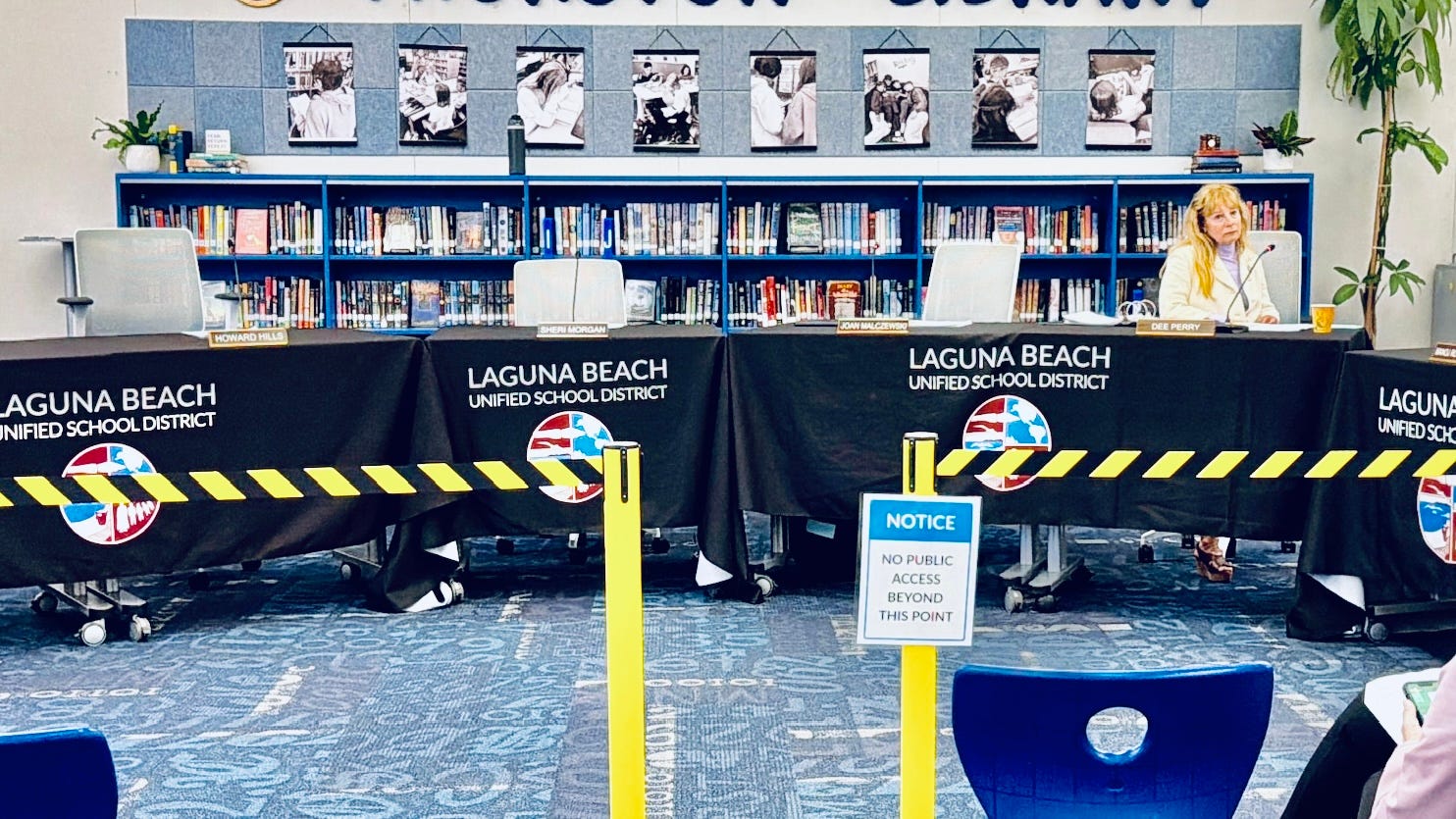
“Safety” became the new frame. President Morgan said the district was investigating the events of May 14. At least briefly during the June 4 meeting, yellow-and-black retractable belt stanchions separated the board area from the public beside a sign reading, “No public access beyond this point.”
Families were exercising their right to criticize elected officials and participate in public life. Police were present, and no citations, arrests, or documented unlawful conduct have been issued.
If records document a specific safety incident, release them. Any law-enforcement contact, investigation, security change, legal review, consultant work, or cost connected to May 14 should be disclosed.
The public should not have to fund a fog machine.
At the June 4 meeting, one speaker rejected descriptions of protesters as “out of control,” “hateful,” or an “angry mob,” along with claims that Dee had been assaulted, pushed down, blocked, or intimidated.
She described families with signs, pom-poms, and chants participating in a protest that was “visible,” “energetic,” and “peaceful.” She also read what she described as Dee’s email from the following morning: “No one pushed me or anything. It was just my knee and fear of being shoved. My fault. I really appreciated your assistance.”
Should the district possess evidence to the contrary, it should produce it. Vague safety language cannot substitute for records.
As another parent explained, “Trust is not built that way. It’s built through transparency during process, not explanations after the fact.”
The June 4 discussion made the original process look worse.
Sheri defended the sudden superintendent appointment by pointing to the superintendent search conducted the previous year. Dr. Austin had reportedly participated, she said, and there was no “statute of limitations” or “expiration date” on that search. Starting over would be fiscally irresponsible because the prior process cost more than $50,000 and took four months.
Joan explained why a process still mattered. It protects against bias, generates better information, safeguards the institution, clarifies governance roles, creates buy-in, and protects the person being hired.
She then returned to the central problem.
“I was not informed at any point that Don Austin was a candidate.”
Joan said she had no prior information about him, no knowledge that negotiations had been underway, and no notice that a start date had been discussed.
“So I’m very curious,” she said. “Who made that determination and why?”
Then came the sentence that deserves to sit on its own:
“Somebody is making decisions and negotiating on behalf of the board with no direction from the board.”
The public record does not yet identify who initiated the discussions, who conducted negotiations, or who decided the prior search could be revived without first bringing the question to the full board.
What it does show is that no new public search process or open-session explanation had been presented. Dr. Austin was suddenly available. A start date had apparently been discussed. A motion appeared. Three votes were there.
Joan and Jim shared they had been left outside the process. Dee said she had been “a little bit in the dark.”
A school board is supposed to act collectively, not through a process that leaves elected trustees learning about a permanent superintendent candidate only after a motion is placed before them.
The question is not only who voted yes.
Who was moving the pieces before the vote happened?
Howard responded by saying people had gotten into the habit of alleging Brown Act violations and that determining a violation was “far more complicated” than commenters suggested. Dee called Dr. Austin a great candidate and said she was thrilled he was available.
Neither response answered Joan.
And now the Orange County District Attorney’s Office has written to LBUSD’s attorney.
Its letter does not find a Brown Act violation and expressly says the office is not opining on potential violations “at this time.” It does say the OCDA received numerous complaints alleging Brown Act violations connected to Dr. Glass’s termination and Dr. Austin’s hiring. The office also received the formal Cure and Correct Demand concerning the May 12 and May 14 meetings.
A senior deputy district attorney in the Special Prosecutions Unit asked LBUSD’s attorney to provide the district’s proposed course of action within seven business days.
For once, the questions have moved beyond public comment silence.
I am relieved the DA’s office has asked the district to state its proposed course of action, even though I do not know how the legal issues will ultimately be resolved. The community deserves clearer answers than the board majority has provided.
How did Dr. Glass’s separation happen? How did Dr. Austin’s appointment come together? Who held discussions, negotiated terms, or made decisions? Were all five trustees given the same information before voting? Which actions, if any, must be cured or corrected? How much public money is being spent reviewing the rally instead of explaining the decisions that caused it?
This board majority repeatedly pushes the legal and practical boundaries of governance, then acts surprised when the community notices. Policy becomes flexible when it is inconvenient. Closed session absorbs decisions the public cannot reconstruct. Transparency arrives after the vote, dressed as explanation.
Three votes can produce an outcome. They cannot manufacture legitimacy.
Dee has a particular responsibility here. She is the longest-serving trustee and knows how a superintendent search and lawful board process should work. Confidential information may have influenced her May 12 decision, but uncertainty about what would come next should have led her to slow the process.
She voted with Howard and Sheri on May 12, seconded the motion to appoint Dr. Austin on May 14, and voted with them again on June 4.
Claims of powerlessness or being “a little bit in the dark” lose credibility when the same vote keeps making the outcome possible.
The board can still release records, explain the timeline, publicly answer the Cure and Correct Demand, and disclose the cost of any investigation, legal review, security response, or consultant work connected to May 14. It can tell the community who knew what, when they knew it, and whether all five trustees received the same information before decisions were made.
Dee still has a choice about the legacy she leaves behind: she can be the trustee who broke with the majority before more damage was done, or the decisive vote that enabled its actions when it mattered most.
She cannot continue wielding power while claiming she has none when the consequences are unfolding in real time.
The third vote is what makes these actions possible, and with every decision it enables, the stakes grow.
History will remember who had the power to stop it and who chose not to.
A Public Record for Laguna Schools provides independent, community-focused coverage of LBUSD to help make district decisions, public records, board actions, and issues easier to follow. If you value this work, becoming a paid subscriber or patron helps make it sustainable by covering the research, writing, and platform costs that keep this information accessible to everyone. I am deeply grateful to anyone who reads, shares, subscribes, or supports this work in any way.
Excellent excellent work Erika
Erika, do you have the letter sent to the board by the Orange County DA? If so, could you send me a copy asap?
Thanks,
Braden Cartwright, Palo Alto Daily Post reporter
bcartwright@padailypost.com