

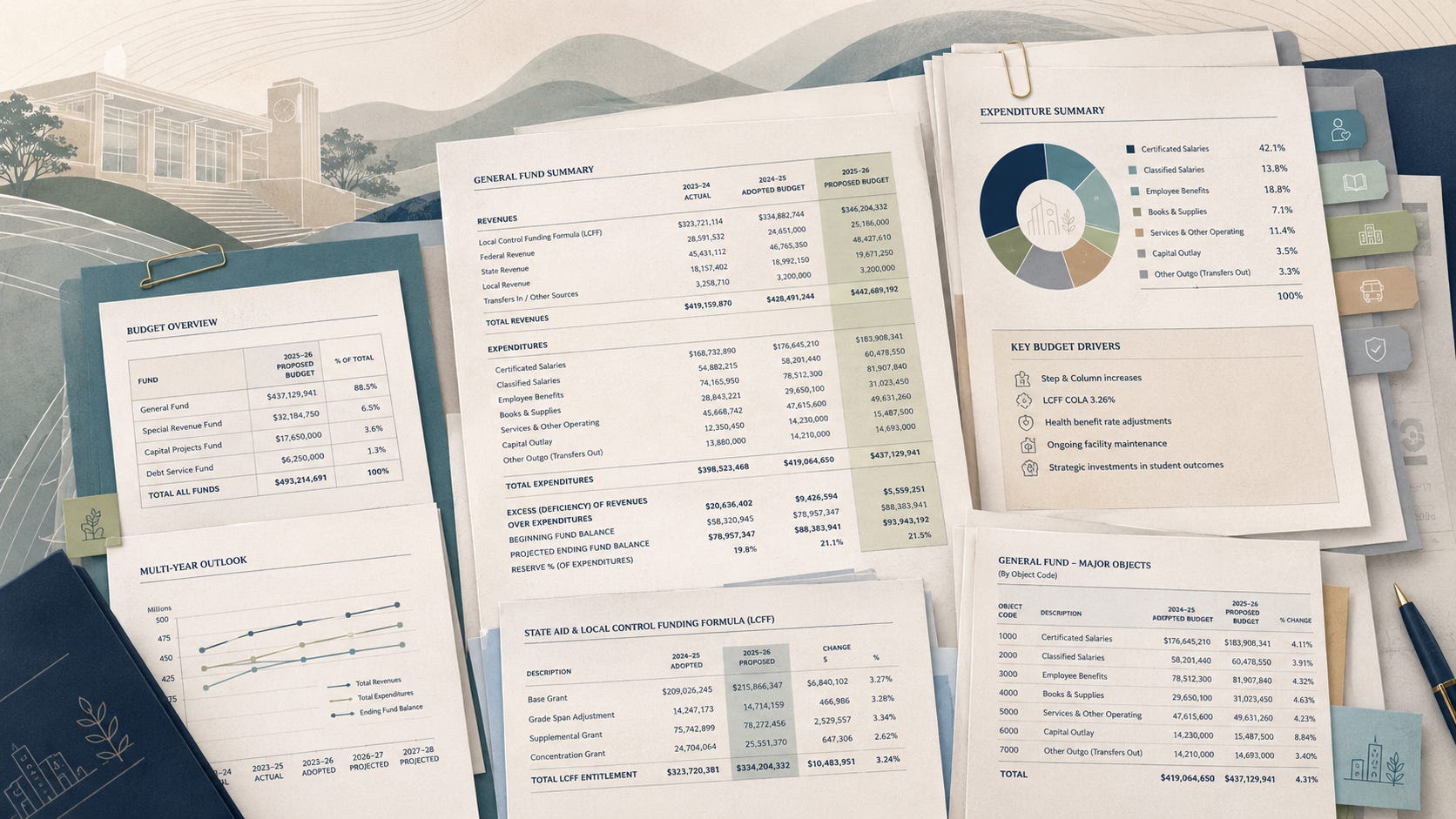
Over the past several years, nearly every major school district debate has eventually become a debate about money. Legal expenses, employee compensation, declining enrollment, reserve levels, a pool, facilities needs, and a possible bond have all raised versions of the same question: How is a school district actually doing financially?
The answer for Laguna Beach Unified is less obvious than the size of the numbers might suggest. LBUSD spends substantially more than it did in FY19, while some reserves are now being used for construction, settlements, facilities, and other major obligations. The District also continues to meet its financial obligations, maintain reserves above the state minimum, receive positive fiscal certifications, and operate without the recurring deficits, emergency borrowing, widespread layoffs, or major program reductions seen in districts under serious financial pressure.
Overall, we remain financially stable, although the District has less flexibility than it did several years ago and we will need to weigh future commitments carefully. Understanding how both conditions developed requires looking beyond the total budget and learning how school district funds are organized.
The most confusing part of a school budget is the collection of fund names, account numbers, restricted resources, assigned balances, and transfers. Fund 01, Fund 17, Capital Improvement, restricted General Fund money, transfers in, transfers out. The documents are public, but they are not written for a normal person to read over breakfast.
California school districts use a standardized accounting system that separates money by revenue source, restriction, program, and expense type. Some accounts are for general operations or restricted to a designated purpose; others are for facilities, repay debt, or held in reserve.
The useful question is where the money lives and what that particular account is allowed or intended to pay for.
The General Fund supports most daily operations, including employee salaries, instruction, counseling, special education, transportation, technology, maintenance, utilities, insurance, and student services. Some General Fund revenue remains restricted, so funds received for arts education, special education, meals, or other categorical programs cannot necessarily be redirected when a different expense becomes more urgent.
Fund 17, formally called the “Special Reserve Fund for Other Than Capital Outlay”, holds an additional operating reserve separate from the legally required General Fund reserve and the capital accounts used for major facilities work. Capital accounts hold money designated for buildings and infrastructure. Bond proceeds must remain separate and may only be used to pay for voter-approved capital projects, while debt-service funds repay the borrowing.
The easiest way to understand the budget is to think of it as a cabinet of labeled envelopes. Some offer considerable flexibility, while others come with legal restrictions, grant conditions, voter requirements, or a specific purpose written across the front. Adding up every envelope shows how much money exists across the District, but it does not show how much is available for a particular expense.
Transfers are especially easy to misread. When money moves from one District fund to another, the first balance drops even though the money may still belong to the District and may not yet have been spent — it has simply been assigned to another purpose.
Government accounting has an impressive ability to make money look missing while documenting exactly where it went.
The pool provides a recent example. LBUSD transferred accumulated one-time resources into capital use for the project. The money was allocated toward a planned facility expense, with local funding coming mainly from separate capital resources and General Fund transfers designated for facilities, rather than directly from Fund 17.
Another example of a documented transfer from Fund 17 occurred just last month, for $4.5 million, for an AB 218 settlement.
Directing available money toward construction can leave less room to increase other reserves, but that indirect relationship does not mean the pool depleted Fund 17. The District funded the pool during years when it was not making new Fund 17 contributions, and those remain separate decisions involving separate accounts.
Another source of confusion comes from comparing financial documents that report different stages of the budget process. The adopted budget is a forecast based on assumptions about property-tax growth, grants, staffing, vacancies, benefits, insurance, construction schedules, and state funding.
The First Interim Report updates the budget using activity through Q1, and the Second Interim Report updates it through Q2. At each stage, the Board certifies whether the District expects to meet its obligations during the current year and the following two years. A positive certification means the District expects to do so, while qualified and negative certifications signal varying degrees of financial difficulty.
After the fiscal year ends (June 30th), the District prepares unaudited actuals, followed by an independent audit. California also requires county-office review of adopted budgets and interim reports.
An adopted estimate should not be casually compared with an audited result from another year. One reflects expectations, another provides the initial year-end result, and the audit examines whether the completed financial statements were fairly presented. These documents cannot determine whether every expenditure was the best policy choice, but they show whether the District met its obligations, maintained required reserves, and remained within California’s fiscal standards.
Districts under severe financial pressure tend to show recognizable warning signs, including recurring operating deficits, depleted minimum reserves, qualified or negative certifications, emergency borrowing, layoffs, program cuts, cash shortages, and difficulty meeting future obligations.
A year in which spending exceeds revenue does not necessarily indicate those conditions, particularly when a district uses accumulated savings for a planned need. A family that saves for years to replace a roof has not become financially irresponsible because expenses exceeded income during the month the work was completed. District reserves similarly allow major one-time expenses to be paid without suddenly disrupting operations.
LBUSD has continued receiving positive fiscal certifications, maintained reserves above the state minimum, and avoided the broad layoffs or program reductions used by districts in distress. California’s fiscal criteria also examine cash, enrollment assumptions, staffing, multiyear obligations, deficit patterns, and reserve levels. The state standard for a district of LBUSD’s size is generally 3% of expenditures and other financing uses.
Laguna’s financial history from FY19 through the proposed FY27 budget becomes fairly straightforward when divided into eras.
Typically when reviewing anydata, FY19 provides a clean pre-pandemic baseline. FY20 and FY21 brought school closures, emergency technology needs, health and safety costs, temporary federal funding, and new demands for academic and mental-health support. From FY22 through FY25, local property tax revenue grew substantially, while the District absorbed higher costs for compensation, benefits, pension contributions, special education, technology, insurance, transportation, student services, and facilities.
Throughout the audited years, the District did not repeatedly close its books in the red or drain its accumulated resources. Total governmental fund balance increased from approximately $43.7 million in FY20 to approximately $61.6 million in FY25.
FY26 and FY27 look different because the District has entered a period of a planned infrastructure project. Pool construction, facilities transfers, and the AB 218 settlement reduce reserves and overall flexibility. Even with those obligations, the FY27 budget showed a General Fund reserve for economic uncertainties of approximately $4.89 million, equal to 5.01% of total expenditures and uses and above the state’s 3% standard.
The overall trend shows rising revenue and spending, strong accumulated balances through the audited period, and a recent decision to use some of that capacity for major obligations. LBUSD has less room than it did several years ago, which makes the quality of future decisions increasingly important, though its financial history does not resemble a district steadily losing control of its finances.
Fund 17 warrants explanation because Board President Sheri Morgan has repeatedly noted that LBUSD stopped contributing to it. The concern is grounded in a real policy question, although the larger context changes how the statement should be understood.
Fund 17 is an additional special reserve, separate from the General Fund reserve required under state standards. An older Board policy contemplated maintaining a “basic-aid differential reserve” based on the difference between LBUSD’s property-tax revenue and the amount it would receive under the ordinary state funding formula. The last contribution appears to have occurred in FY20.
As property-tax revenue increased, the theoretical target grew as well. By 2026, the policy calculation suggested a target approaching $49 million, roughly half a year of District expenditures, while Fund 17 held closer to $24 million before the later AB 218 transfer.
A community-funded district has good reason to maintain strong reserves because property-tax revenue can fluctuate and state law can change. Adding another $25 million to a special reserve, however, would withhold that money from current students, employees, programs, facilities, and other obligations. The policy raises a reasonable question about how much additional protection LBUSD should maintain and whether a formula created under different financial conditions still reflects the District’s risk.
The Board should follow the policy, clearly explain why contributions are being deferred, or revise the formula through a public process. Leaving an old policy in place while repeatedly choosing another course makes the budget harder to understand and creates suspicion.
The gap between the Fund 17 balance and an aspirational policy target should not be confused with failure to meet the legally required reserve. The first reflects a local decision about additional protection, while the second establishes the minimum financial standard for District operations.
Legal spending also warrants scrutiny. LBUSD’s legal expenses rose from roughly $250k in FY23 to approximately $1 million projected in FY26, with another $1 million budgeted for FY27.
Those costs include special education disputes, employment matters, facilities and contracts, historical abuse claims, public-records requests, governance advice, investigations, litigation, and settlements. The First Interim Report in FY26 identified legal and consulting services as one component of the increase in services and operating expenses, but I could not find public documents that provide enough detail to determine how much growth belongs to each cause.
Some pressures affect districts across California, including special education disputes and exposure created by changes to the statute of limitations for sexual abuse claims. Other expenses could have arisen from LBUSD’s governance disputes, personnel matters, investigations, Brown Act complaints, and public-records conflicts.
The community needs categorized reporting to assess the increase. Maybe there could be a quarterly report that divides legal spending into broad areas such as special education, employment, facilities, governance, public records, investigations, litigation, and settlements while protecting privileged legal advice. A million-dollar legal budget naturally attracts attention, but without an explanation of what produced it, the number generates more suspicion than understanding.
California already requires a substantial budget process. Laguna Beach’s School Board must hold a public hearing and adopt an annual budget, the Orange County Department of Education reviews the budget and interim reports, the District issues multiyear fiscal certifications, year-end results are published, and an independent audit is completed each year.
The Board’s role includes establishing policy, approving spending, monitoring results, and requiring corrective action when systems fail. Fiscal seriousness comes from understanding the numbers, explaining the choices, and following through on adopted policy rather than relying on the size of a number to supply the argument.
School budgets invite confusion because transfers can resemble losses, reserve goals can resemble shortages, and planned capital expenses can resemble ordinary operating waste when every fund is treated as one enormous pile of taxpayer money. Laguna is fortunate to have strong local revenue, healthy reserves, excellent programs, and the ability to invest in long-term needs, although preserving that position will require thoughtful choices about what should be funded, what should be saved, and which financial tool is appropriate for each obligation.
A Public Record for Laguna Schools provides independent, community-focused coverage of LBUSD to help make district decisions, public records, board actions, and issues easier to follow. If you value this work, becoming a paid subscriber or patron helps make it sustainable by covering the research, writing, and platform costs that keep this information accessible to everyone. I am deeply grateful to anyone who reads, shares, subscribes, or supports this work in any way.