

I was not at the May 14 protest, but the people there were not strangers to me.
They were my friends, neighbors, my kid’s coach, and the parents I see at school events, on the sidelines, in parking lots, and around town. They were the people who talk when something feels wrong, show up when it matters, make signs in someone’s kitchen, buy snacks at Costco, bring the kids, and somehow turn a group chat into civic action before dinner.
In other words, they were acting the way people in Laguna Beach often act when something feels wrong: they showed up to exercise their First Amendment rights.
Of course, this is the part the Board majority now seems very keen to blur.
On July 7, the ACLU of Southern California sent a letter to LBUSD alleging the Board violated the Brown Act by discussing the May 14 protest in closed session. The letter was sent on behalf of local parent Meredith McMahon, who helped spark the protest and, from what I can tell, felt a duty to defend what that protest actually was.
To be clear, Meredith is not suing the district for personal financial damages, nor is she seeking a payout. The ACLU letter clearly asks the Board to fix the alleged Brown Act violations and commit to not repeating them. If litigation ever follows and attorney fees become an issue, that would be about legal fee recovery for the ACLU under the Brown Act, not money going to Meredith.
The ACLU letter is bigger than one parent, one protest, or one very Laguna group-chat mobilization. It asks whether the Board majority can take public criticism, reframe it as a safety threat, send it to legal counsel, and then hide the response from the public.
The May 14 protest grew out of the Board majority’s sudden separation from Dr. Jason Glass, which the district described as mutual, even though many parents did not see it that way.
So parents showed up publicly to object.
They had signs. They chanted. They were loud. They were angry, and definitely not subtle. There were “shame” signs, handmade posters, kids, snacks, and even pom poms, because apparently Laguna moms can turn constitutional expression into a spirit squad if given enough notice.
Was it uncomfortable for the Board? I am sure it was.
Was it embarrassing? Probably.
Was it public criticism of elected officials? Absolutely.
And that is protected speech.
The First Amendment is not a feelings-management policy for public officials. It does not protect only soft voices, flattering signs, and calm comments delivered at a podium by the dais. It protects speech, assembly, and petitioning the government, including signs, chants, criticism, and public pressure elected officials may find deeply unpleasant.
Public agencies can enforce reasonable rules about safety, access, noise, and keeping meetings functional. However, this is about the Board majority appearing to take a loud but peaceful protest and recast it as something more troubling.
After the protest, the Board majority’s storyline started to shift. Trustee Dee Perry stumbled while trying to enter the building. Available videos show Perry struggling to enter, with Ketta Brown helping her inside. These videos do not show protesters pushing her, and Perry later stated in the Laguna Beach Independent that she was not pushed.
Shouting, chanting, holding signs, or criticizing elected officials may feel intense, uncomfortable, and even overwhelming. Absent a physical act, an attempt to apply force, or a direct threat of immediate violent injury, fear alone does not turn protected speech into assault. For example, a stumble near protesters does not automatically render a threat to public services or facilities.
But Dee Perry’s fall became the Board majority’s permission slip to reframe the May 14 protest.
A parent protest over Dr. Glass’s sudden exit escalated into a “safety incident,” which then became a legal matter. Then the legal matter became a closed-session discussion the public was not allowed to hear.
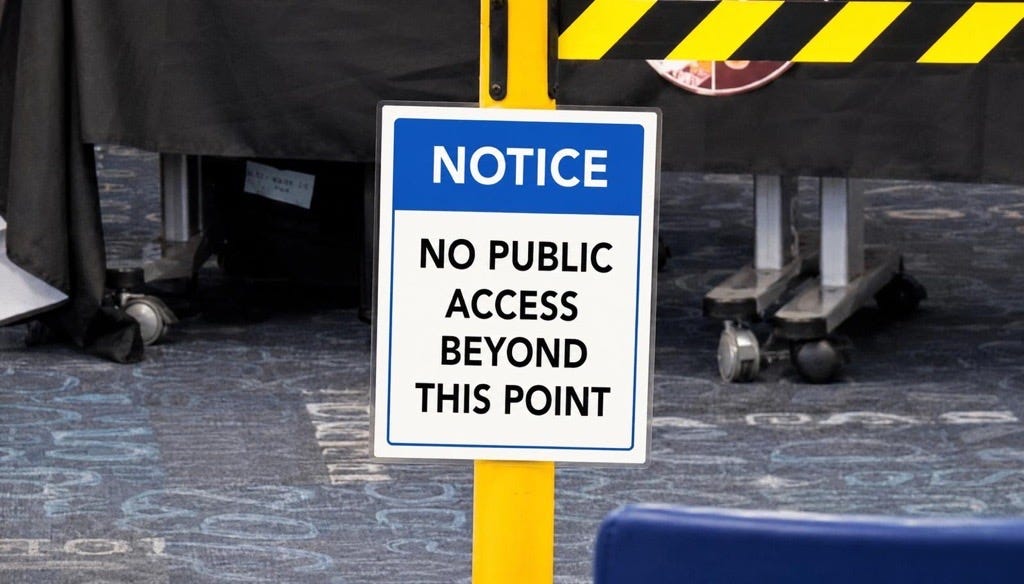
By the June 4 meeting, the Board’s posture had visibly changed, with notice-restriction signs and stanchions appearing. Then came the June 8 closed session.
According to the ACLU letter, the Board discussed the May 14 protest under a closed-session item related to “threats to public services or facilities.” Afterward, Board President Sheri Morgan reportedly stated that no reportable action had occurred. She also said safety concerns had been raised after the May 14 rally and that the Board had requested legal counsel or a designee to look into the rally, including what occurred, whether safety protocols were followed, and whether Board policy or law had been violated.
That is the kind of sentence that makes normal people blink twice.
No reportable action occurred, but the Board requested legal counsel or a designee to investigate the rally?
The ACLU argues that LBUSD improperly used closed session to discuss a public protest under a narrow Brown Act exception meant for actual threats to public services or facilities. The letter also argues that the public agenda did not give people fair notice that the Board would discuss the May 14 protest or whether to investigate it.
The Brown Act exists because public agencies must conduct business in public unless a narrow exception applies. Closed session is not where elected officials process feelings about criticism, nor is it a panic room for uncomfortable public feedback.
The ACLU’s point, as I read it, is simple: the Board cannot take a public protest, call it a threat, discuss it privately, and then tell the public there was nothing to report.
Especially when the “threat” appears to be parents speaking up.
That is how public speech gets silenced — it is not always by a direct order to stop talking. Sometimes it happens through vague safety language, shifting narratives, closed-session agenda items, and lawyers looking into what parents did.
I am not a lawyer, but I work at a public institution and follow First Amendment regulations in public spaces. I know the difference between protest and disruption. I know access and safety are important. I also know public agencies cannot use “safety” as a cover for viewpoint control.
The government does not get to treat public criticism as a threat just because the criticism is loud, embarrassing, or effective.
If the Board had legitimate safety concerns, it could have addressed them openly. If protest logistics needed better management, it could have said so in public and allowed the community to respond.
Instead, the Board used closed session to discuss the protest under a “threat” exception and then reported that legal counsel or a designee had been asked to look into it.
The protest was public, so the Board’s response should have been public.
The First Amendment does not just belong to the Board majority — it belongs to us, too.
A Public Record for Laguna Schools provides independent, community-focused coverage of LBUSD to help make district decisions, public records, board actions, and issues easier to follow. If you value this work, becoming a paid subscriber or patron helps make it sustainable by covering the research, writing, and platform costs that keep this information accessible to everyone. I am deeply grateful to anyone who reads, shares, subscribes, or supports this work in any way.
When the meeting is noticed the library turns into a public meeting space not a school space. Sheri doesn’t understand the difference. Howard Hills who is NOT a licensed attorney is costing this district hundreds of thousands of dollars because he thinks he is the expert on Brown act and civil rights and it is hurting our district.
What really confuses me is Dee insinuating she was terrified. I was sitting inside at the dais as the protest happened trying to write my board report for the meeting. We saw Dee walk in I watched her giggle and look at Howard and state” well that was awkward” as she set her stuff down on the dais then walk over to where the food was laid out and ask Victoria “who catered tonight this looks beautiful”. We also watched as Victoria closed the back door where the protest was going on and the. Watched Howard go open it back up again. I also watched as he videotaped children that were holding signs waiting inside for the meeting to start. If that is someone who feared for her life she sure didn’t react that way when she walked in.