Surely the Next Audit Will Find Something
After multiple investigations failed to uncover the intentional misconduct some expected, LBUSD is considering spending another $125k to examine its past.

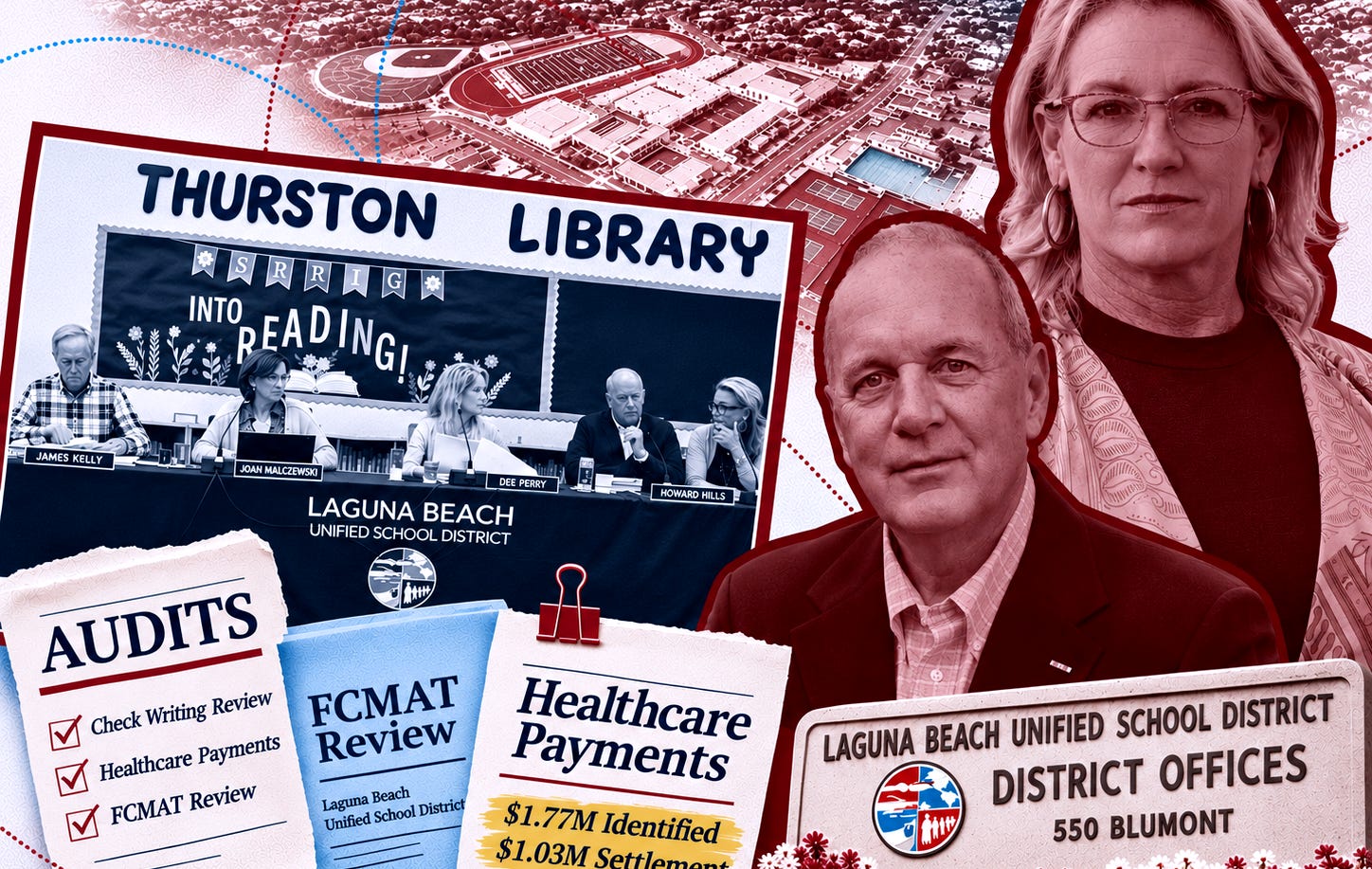
At some point, after enough audits, investigations, and increasingly confident accusations, you would think we’d start paying attention to what the auditors are actually finding.
Laguna Beach Unified has years of clean financial audits, a AAA credit rating, and now an independent FCMAT investigation that identified real administrative problems but found no evidence that district personnel intentionally misused or concealed healthcare funds.
Given the accusations made against former Superintendent Jason Viloria, previous administrators, and current employees, that’s a fairly significant conclusion.
And yet, at the November 19 board meeting, trustees will consider another investigation, this time looking back ten years, with professional fees up to $125k, plus expenses. It seems like when findings don’t live up to the allegations, there’s always another year to investigate.
I’m all for financial accountability, but after more than a year of accusations and multiple investigations, I’d like to know what we’ve already paid to find out before committing to more.
Every year, LBUSD undergoes an independent financial audit. Auditors review financial statements, test records and controls, and examine compliance with specified requirements. A favorable result, called an unmodified opinion, means the statements fairly present the district’s finances in all material respects. It doesn’t mean every transaction was perfect or that a targeted investigation could never uncover a problem. Still, it does mean something. Otherwise, why do we pay for annual audits?
LBUSD received unmodified opinions for FY23, FY24, and FY25, including favorable results for the federal programs and state requirements examined. Some management letters identified weaknesses requiring correction, particularly in student activity accounts. But the overall financial record has been consistently favorable.
The district also reported an S&P AAA credit rating with a stable outlook, the highest rating category available. Its FY25 audit identified $4.5M in available General Fund reserves, above the applicable 3% benchmark. That doesn’t eliminate questions about spending priorities or future obligations, but it complicates the suggestion that district finances have operated without meaningful oversight.
After Viloria left, Eide Bailly reviewed district contracts and checks amid suspicions that he continued authorizing payments. The contracts examined produced no findings. His signature remained preprinted on checks, but his ability to initiate payments had been removed two days after his departure, and two payments made to him had supporting approvals. Importantly, the review did not establish that Viloria continued controlling district payments after leaving.
The healthcare investigation, on the other hand, found a real problem. The district paid more toward employee healthcare premiums than its collective bargaining agreements. Michael Bishop & Associates examined the issue, and district staff subsequently calculated its financial impact.
This is where the $1.77M figure debuted. The number represented gross above-cap contributions for several years, including a projected amount for FY26. District staff subsequently calculated approximately $1.04M after accounting for earlier years when contributions were below negotiated limits and $350k associated with a 2021 healthcare agreement.
Neither number was a final, independently certified amount recoverable from employees. FCMAT did not repeat Bishop’s testing and questioned how certain offsets were applied, including how the $350k agreement was treated. Individual employees may also have overpaid or underpaid depending on their coverage.
At the December 16, 2025 meeting, the board unanimously voted to absorb approximately $1.04M rather than seek repayment through employee compensation. Jim Kelly moved, Joan Malczewski seconded, and Howard Hills, Sheri Morgan, and Dee Perry voted yes.
All five trustees supported that decision.
I support protecting employees who relied on contribution rates administered by their employer. But as FCMAT subsequently explained, absorbing the amount in the budget did not necessarily resolve the district’s legal obligations.
In July, OCDE engaged FCMAT for an extraordinary audit following requests from community members. The review went beyond healthcare contributions to examine Bishop’s selection, outside employment by district personnel, and the AI Trust You application.
When I wrote Nothing Says Summer Like a Fiscal Review, I expected auditors to identify administrative failures, weak controls, and a need for corrective action. I also expected the evidence to fall short of the much more serious allegations of intentional misconduct. I was comfortable making that distinction then, and I feel vindicated by what the report actually says now.
On page 11, FCMAT states:
“FCMAT did not find evidence that district personnel intentionally misused health benefit funds or concealed the employee health benefits overpayment.”
There it is. Not a union talking point or my personal interpretation of what happened. The official, state-backed, independent investigators’ conclusion.
Howard has publicly questioned the actions of previous administrators and asserted that current and former senior staff and union leaders knew about what he characterized as an unlawful healthcare subsidy. He has repeatedly raised concerns about the district’s handling of these payments, including suggestions of concealment and deliberate wrongdoing.
The contribution errors he criticized were real, but FCMAT did not substantiate any of his allegations of intentional misuse and concealment.
The investigation also found no evidence that the outside employment it examined violated district policy or improperly used district resources. Its inquiry into AI Trust You found no support for unaccounted-for billing among the districts that responded. Nor did it find evidence that a professional connection compromised Bishop’s selection or work.
When allegations about identifiable people’s professional integrity are made publicly, findings that fail to substantiate those allegations deserve equal attention.
There was also a serious unresolved finding. FCMAT found sufficient evidence that a gift of public funds may have occurred because of the excess healthcare contributions.
Under California law, a potential gift of public funds can exist even without evidence of intentional wrongdoing. The district needed legal authority for contributions above the contractual caps and a legally sufficient resolution of those payments.
Although all five board members voted to absorb the costs in December, FCMAT had not been provided evidence that negotiations resolving past excess contributions had taken place. Later agreements about future healthcare contributions do not automatically settle that question.
The district still needs to reconcile the amounts, determine the appropriate legal remedy, and document the necessary bargaining and board action. FCMAT also recommended notifying state officials and the district attorney regarding the potential gift finding, which is not a finding of criminal misconduct.
And now, on November 19, the board will consider a contract with Baker Tilly, listed as Consent Calendar Item 12H. Unless pulled for separate discussion, it could be approved alongside routine business. An interesting place for a six-figure investigation from a board that talks so often about transparency.
The original proposal covered five years, with professional fees capped at $90k. Revised materials posted November 16 expanded the review to ten years and increased the professional-fee ceiling to $125k, with data processing and reimbursable expenses on top.
The proposed work would examine bank transactions, vendor payments, purchasing cards, fund transfers, selected controls, and long-term financial projections.
There may be legitimate questions worth investigating, but then the Board needs to identify them. Explain why a decade of review is necessary, which gaps in previous work remain unresolved, and what the public will receive when it’s finished.
The engagement letter describes advisory work using selective testing, rather than another financial-statement audit. The agenda also indicated that district counsel’s legal review was incomplete when the item was posted, which is worth discussing.
Additionally, section 7 of the proposed agreement restricts the district from disclosing Baker Tilly’s work product to third parties or referencing it publicly without the firm’s written permission, which cannot be unreasonably withheld. That provision does not necessarily override California public-records requirements, but it certainly raises questions about how the public will receive the findings.
We’re considering spending up to $125k in professional fees, plus expenses, on an investigation intended to provide additional financial oversight, while the agreement restricts discussion or distribution of its results.
It would be helpful to clarify that before signing.
There’s also some irony in the consent-calendar placement. At the December 11, 2025 meeting, Sheri moved, Dee seconded, and the board unanimously directed staff to develop rules making consent items over $50k separate action items.
This raises a fair question: if $50k deserved its own discussion, why is a $125k professional-services contract sitting on the consent calendar?
And why now?
The new board’s organizational meeting is scheduled for December 15. Approving the contract now could allow work to begin and costs to accrue before incoming trustees can evaluate whether the investigation is necessary.
The district’s transactions from ten years ago will presumably be there for another few weeks.
The Baker Tilly contract should not move forward as proposed. At minimum, it should be removed from the consent calendar for separate public discussion, with approval deferred until the new Board can evaluate the need, cost, legal terms, disclosure provisions, and proposed deliverables.
The community deserves a clear explanation for the expanded scope and urgency before the district commits additional public money. I hope residents will ask the board to pull Item 12H and defer the decision.
We have documented financial errors that need correction, a potential gift-of-public-funds issue that requires legal resolution, and serious allegations of intentional misconduct that independent investigators did not substantiate. Yet the response on the table is a broader, more expensive investigation into the past.
I also believe Howard owes an apology to Jason Viloria and the former and current district employees whose professional integrity he publicly questioned. He was entitled to pursue legitimate concerns, but when serious accusations become part of the public record, findings that fail to support them should be acknowledged just as publicly. Fairness to the people you serve needs to be part of the job.
We’ve spent considerable time and public money searching for answers. We should address the problems these investigations identified, implement their recommendations, and correct the public record where allegations went beyond the evidence.
At some point, accountability means accepting the findings, not commissioning another audit because you don’t like them.
A Public Record for Laguna Schools provides independent, community-focused coverage of LBUSD to help make district decisions, public records, board actions, and issues easier to follow. I am deeply grateful to anyone who reads, shares, subscribes, or supports this work in any way.
Such a great article explaining the issues. I really wish they would just directly say what they’re looking for or what they believe has happened.
Excellent piece once again. No more audits or investigations, and if they do vote to pursue it, they may not like what they find, as has been the case so far. Employees overpaid insurance for a time, so they should carefully consider this action item.